
What can AI Max do now that it has been a year?
We are nearly a year out from the AI Max big reveal, and artificial intelligence has made a dent in every facet of paid search marketing. Major brands are no longer shying away from the use of AI in creative; everyone has their own AI tool they want you to buy into, and AI-driven algorithms are more visible now than ever before.
We’ve crossed the AI Max Rubicon, but what does this mean for us as digital marketers in 2026?
How AI Max Actually Works
When it comes to the current reputation of AI Max, it’s been something of a volume play. There are hundreds of thinkpieces out there that tout the tool’s theoretical capabilities. While those can be helpful, it’s a bit harder to find authentic, firsthand accounts of AI Max’s very real flaws.
Ideally, AI Max allows marketers to find new avenues for highly relevant traffic, on top of established modes of delivery—think exact-match targeting, broad-match keywords, or search themes.
However, this just isn’t the reality. Instead of expanding your reach, AI Max cannibalizes your current keyword setup, eliminates delivery, and reduces it to a fraction of what it was spending before the introduction of AI Max.
Here are Google’s AI Max launch recommendations:
- Add AI Max to existing campaigns struggling to spend their budgets due to a lack of search volume.
- Use AI Max for prospecting campaigns to show for search terms you wouldn’t normally be able to reach.
- Use AI Max to create on-the-spot copy hyper-relevant to your customers’ search patterns.
But we saw something different: AI Max hijacking our campaign’s performance and supplanting high-quality results previously delivered by exact and phrase-match keywords.
AI Max and Broad-Match Fail to Outperform Exact and Phrase
We launched AI Max, aligned with Google’s recommendations, and our spend shifted heavily toward broad match (90%), with exact and phrase match dropping below 10%—resulting in 4x higher CPAs. Broad-match failed to outdeliver its exact and phrase-match counterparts, which is why, when we implement Broad-match, we use guardrails.
But all this brings us to a hidden silver lining:
How AI Max Works as an Exact-Match Tactic
It seems that implementing sweeping negatives (and we mean sweeping) forces AI Max to innovate, AKA deliver exact-match results using AI Max techniques and without broad-match eating up spend.
This approach doesn’t provide incremental additions to our range of search traffic, but did we really need that many more? Maybe the Nike’s and Walmart’s of the world are missing out on some searches just by pure virtue of scale, but what about the other 99% of advertisers using Google Ads to further their own goals?
We took a step back and determined that AI Max would prove useful in providing a better way to deliver the things we already know are good. What if we can strip things down to the basics, instead of placing trust in the unproven?
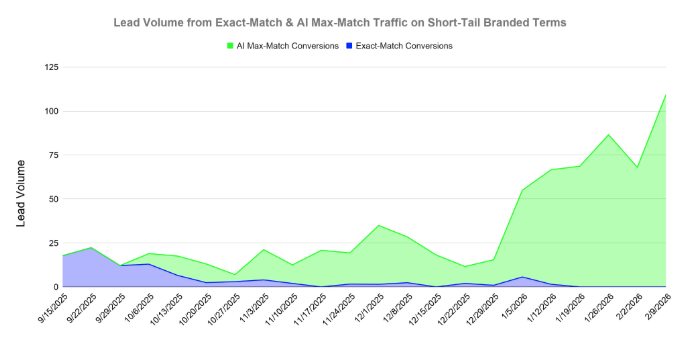
Here’s how AI Max performed when we added 375 negative keywords, forcing AI Max to deliver for a single branded term, and how that differed from a standard phrase + exact branded search campaign.
If you’re wondering why, here’s some context:
We knew this term was a strong one, but our branded search campaigns include a mix of exact, phrase, and close variants. It reliably performed well at a high level of efficiency. It definitely wasn’t expected to be a part of a net-new strategy or growth.
But AI Max had one thing that our other campaign didn’t: a new match type.
The AI Max Match Type
There is no definition for what the AI Max match type actually is, other than this:
“Google AI will learn from your current keywords, creatives, and URLs to help you show up on more relevant searches.”
As we mentioned before, when it comes to net new search term performance, the AI Max’s match type is worse than the best practice exact, phrase, and broad match types. But there is one thing it does very well – so well, in fact, that it rapidly ascended to one of our favorite new tools.
Driving Hyper-Efficiency on Simple Branded Search Terms
For many companies, branded search is a small element of overall strategy. It doesn’t drive significant net-new customers, and it’s not going to make up a big portion of your total spending.
Nevertheless, it’s still important to have a solid branded search strategy. That means keeping CPCs low and generating as efficient a return as possible. That’s why branded search budgets stay low. How can you expand your presence when you’re paying 15 cents a click? With AI Max, that’s how.
Remember the couple of hundred negative keywords we mentioned? After we added them, 91% of our spend from AI Max went to a single, high-performing, exact-match branded search term.
In our standard branded search campaign, that same term made up only 3% of total spend.
- Clicks on this term increased by 1,487% in the AI Max campaign.
- Lead volume on the term increased by 1,716%, and our impression share rose as well.
Rapidly scaling up the term also bumped CPCs (+57%) and CPAs (+37%), but this was acceptable given the massive efficiency gains, maximizing the opportunity for this term to convert in a competitive auction where we must defend our brand position.
What Does This Mean for the Future?
Exact-match AI Max is certainly one of the more unexpected ways that AI Max has found its niche within our strategies, and there will no doubt be more to come in the future.
It’s clear, however, that it’s up to us as diligent digital marketers to find those solutions; Google isn’t going to give us the instructions (or make it easy).
Staying cognizant of industry updates is important, but think outside of the box, stay agile, and look for creative opportunities to use AI Max where it makes sense — based on, first and foremost, your own data.
This is just the beginning of the potential of AI Max, but it’s not what AI can discover. It’s about improving already perfected elements.In this case, it meant starting with Branded Search.
Wondering if exact-match AI Max is the right move for you? We’re happy to dig in and discuss strategies for getting you and your team where you need to be. Reach out to us using our contact form, or connect with us on LinkedIn.