

Authors: James Glew, Morgan Ferriss, Emily Myers
Google’s flagship “smart” campaign, AI Max, promises to revolutionize PPC for retail. We ran the tests to see if it delivered. Spoiler: the results didn’t match the hype.
What Is AI Max?
Before diving into what AI Max is, it’s important to understand what it isn’t. AI Max is not:
- A surefire way to get ads into the AI Overview
- A replacement for Performance Max (PMax)
- A more efficient way to reach your customers
- Superior to exact or phrase match
- The future
Let’s start by breaking down the features of AI Max campaigns.
| AI Max Tools: Pitch vs. Reality | ||
| Feature | Google’s Pitch | Reality |
| Search term matching | Smarter matching | PMax already does this |
| Text customization | AI-generated copy | Often low quality |
| Final URL expansion | More relevant landing pages | “Relevant” ≠ conversions |
| Locations of interest | Audience expansion | Limited; others do it better |
| Brand/URL controls | New options | PMax already covers |
| Reporting | More visibility | No AI placement transparency |
When AI Max launched in summer 2025, we ran controlled tests across multiple accounts. Following Google’s recommendations, we enabled every available setting to see how it really stacks up.
Here’s what we learned.
AI Max vs. Keyword Campaigns
Google’s main claim surrounding the effectiveness of AI Max campaigns versus standard RSAs is: “Advertisers that activate AI Max in Search campaigns will typically see 14% more conversions or conversion value at a similar CPA/ROAS. For campaigns that are still mostly using exact and phrase keywords, the typical uplift is even higher at 27%.”
The selling point here is, basically, “who wouldn’t want one click to get 27% more conversions?”
But let’s compare the actual performance of AI Max versus identical campaigns that utilize phrase, exact, and broad match keywords.
Test #1
Our standard search campaigns were generating an average CPA of $143 at a reasonable scale. Our expectation was that launching AI Max would help us reach additional traffic more effectively. During the brief test, our AI Max campaign did not deliver.
We saw CPAs from AI Max 84% higher than their RSA counterparts.
The only terms from AI Max that actually generated a sale were simplistic one- or two-word searches, which were already covered by exact match keywords. Even more concerning was their over-representation in the resulting traffic of the AI Max campaign relative to the control.
Simple search terms (e.g., “Levi’s”) comprised more than 33% of all impression traffic from the AI Max campaign, compared to 11% in our control group.
Test #2: AI Max vs. Broad Match
Let’s look at the differences at the search term level between an AI Max campaign, and our Eight Oh Two best practice broad match campaign.
AI Max was reined in for this test but still drove 3,820 impressions—compared to 115,820 delivered by our broad match inclusive campaign. In all, these two campaigns delivered 13,611 unique search terms. Of these, only 188 search terms from AI Max weren’t also covered by our broad match campaign.
Language Comprehension
Outside of overlap with pre-existing coverage, there are issues with AI Max’s language comprehension skills. The tool frequently misinterpreted words that can have multiple meanings. For instance, if someone was searching “how to wash” something, versus a specific “wash” of jeans, the AI Max tended to show ads for terms including the wrong kind of “wash” more frequently than in our broad match campaigns.
Search Term Results
In our standard campaign, single-word, high-performing terms (“Jeans”) were present in 93% of all search impression volume. In our AI Max campaign, these terms were similarly present in 84% of all impression volume.
It appears AI Max was trying to branch out and get more creative. But 65% of all traffic delivered by AI Max was identical to what we were already able to achieve, so we decided to look into the remaining 35% to find any incremental benefits. The silver lining was slim.
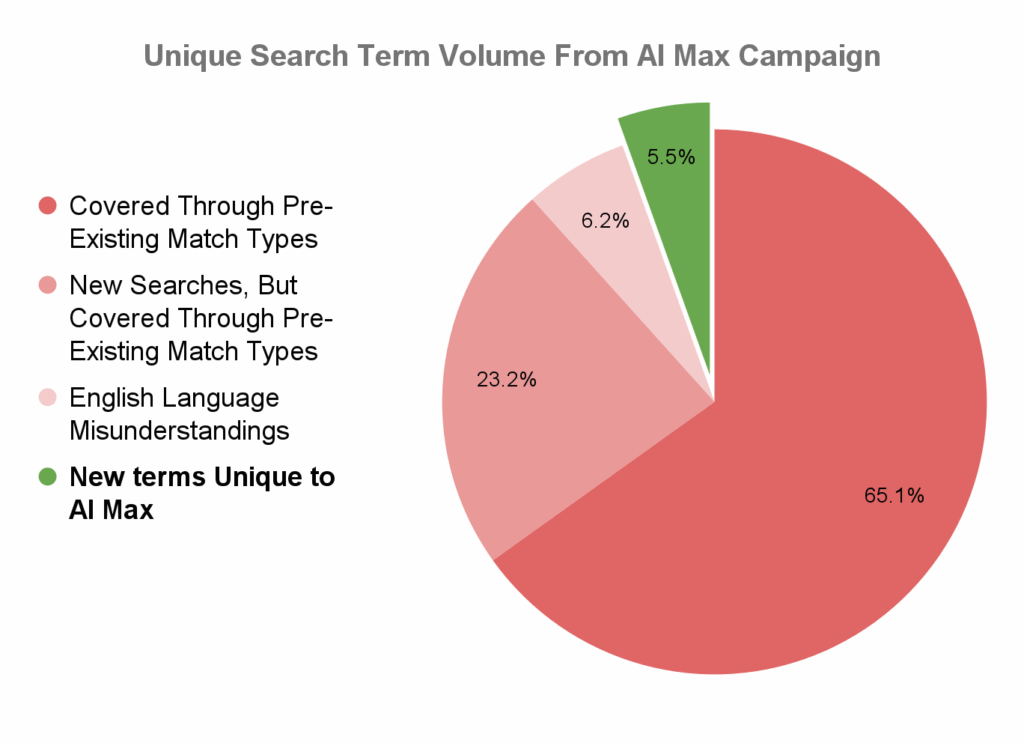
Only 5.5% of our campaign’s search terms were net-new. The takeaway? AI Max is not going to revolutionize your campaigns and expand your reach significantly.
Bad Headlines
Google’s AI Max campaigns generated headlines that were identical to preexisting copy at best and totally irrelevant at worst. For every headline perfectly tailored to a user’s search query, there would be 100 that met the bare minimum or even repeated elements of the headline for no reason. Examples:
- Unlimited Returns | Unlimited Returns | Unlimited Returns
Dynamic keyword headlines didn’t work at all. It just showed the text, brackets and all:
- {Keyword: Top Jeans for Men} | Order Today
It was clear that the campaign type was throwing a lot of copy at the wall to see what stuck.
Thankfully, Google has recently launched the ability to guide your headlines. We look forward to implementing this new “text guidelines feature” in AI Max campaigns and measuring its impact.
Worse Landing Pages
When it comes to URL inclusions, it’s always been a mixed bag. Best practice demands numerous URL exclusions, which can be unwieldy for retailers with large SKU counts. While AI Max uses a robust web crawler to find the part of your site best suited to a given search query, it isn’t always aligned with driving sales and can lose sight of the primary objective once it gets going.
The AI Max Future We Were Promised
It’s not all bad. AI Max is a tool for rapid growth that can be utilized by retail paid search advertisers without a comprehensive campaign structure in place.
There were instances where it hit the mark. We saw success when AI Max was one of few campaigns active and there was not a significantly strong control group counterpart. But is it really a test if there’s no control? (When it comes to A/B testing, our guidelines lay out what it takes to analyze your performance for standard tests.)
This performance was similar to what we would have seen coming out of a best practice search campaign. And once we had a control group in the mix, AI Max paled in comparison.
AI Max was able to identify a search for a uniquely named product (e.g., “Engineered Jeans 1999”) and attempted to drive the user to the correct landing page. Although the landing page was connected to an outdated part of the site, the query still resulted in a high-value conversion.
The ability to provide guidance to AI Max campaign headline generation was just added, so there is hope for the product looking forward.
So, What Do We Do With AI Max?
Google will undoubtedly keep investing in AI-driven tools, from flashy products like AI Max to behind-the-scenes engines powering PMax.
Instead of abandoning AI Max when it doesn’t perform as expected, test it with guardrails.
By adding broad match negatives—and lots of them—you can control the delivery of AI Max to a greater extent. AI Max with comprehensive broad match negatives forces the campaign to deliver only for AI Max search terms. The addition of broad match negative keywords saw traffic from one campaign drop by 95%, but AI Max search terms grew in spend by 800%.
In another test, we set our campaign live for one month without broad match negatives, and then one month with the negatives.
| AI Max Campaign Percent of Spend by Match Type | ||
| Match Type | Before Broad Match Negatives | After |
| Exact | 0% | 0% |
| Phrase | 26% | 12% |
| Broad | 35% | 31% |
| AI Max | 8% | 11% |
| “Other” | 30% | 46% |
At launch, AI Max search terms comprised 8% of campaign spend and had a CPC 7% lower than the campaign average. After implementing negatives, 11% of all traffic came from AI Max terms. We saw conversions on very high-intent queries where AI Max guided the user to the most relevant part of the site it could find. AI Max CPCs also became even more efficient, now 14% lower than the campaign average.
Our AI Max Campaign found a user searching for rare jeans, created a custom headline featuring those rare jeans, and took them to the page for rare jeans, where they made a purchase.
| Search Term | Headline | URL |
| Rare Engineered Jeans from 1999 | Rare Denim | Levi’s Engineered Jeans | www.jeansstore.com/rarejeans/engineered-jeans-1999 |
We also saw the “other search terms” category grow in our results. There is admittedly not much action we can take on this “other” category. But we’ve seen time and time again that new techniques resulting in an increase of “unknown buckets” often mature to strong strategies applicable across many use cases.
It’s important to note that AI Max only succeeded this way 1% of the time, and 99% of the traffic was much less impressive. That’s why we recommend giving this test a go—with extreme caution.
AI Max Best Practice Checklist
Here’s how we plan to approach AI Max after learning from our initial tests, following Google’s instructions, and then throwing them away altogether.
For now, AI Max is useful as a supplement to existing best practice campaigns while leveraging the new AI Max search term match type. Want to see how we can deliver for you and your clients? We’d be happy to dig in and discuss strategies—we do a lot more than just AI here! Reach out to us using our contact form or connect with us on LinkedIn.