


Developing effective generative engine optimization (GEO) and search engine optimization (SEO) strategies for your home goods and decor brands requires a combination of industry knowledge and masterful optimization skills. As search continues to shift toward AI-driven results, the difference between SEO and GEO comes down to how clearly your content can be understood, not just how well it ranks in traditional search results. But adapting your approach doesn’t mean starting from scratch. Instead, it means evolving a traditional SEO strategy into a more effective approach to GEO for home brands.
If you’ve ended up here, I can hazard a guess that you’re in one of two positions: Either you’re just starting on optimization strategies for a burgeoning home decor brand, or you’re looking for ways to switch course and salvage an ineffective strategy.
Luckily, I’ve spent the past several years helping new and established home decor brands improve search performance and customer conversion. While I can’t download all of my experience directly into your brain, I can share some of the lessons I have learned. Here are my core home decor SEO and GEO strategies for brands looking to appear in both traditional rankings and AI overviews (AIO).
A Quick Overview of How GEO Differs for Home Decor Brands
GEO matters a little differently for home decor brands because customers don’t shop for these products based on one simple keyword. Often, they’re comparing materials, styles, dimensions, and use cases all at once, sometimes across multiple searches. That makes precise language especially important. When I’m writing for home decor, I want those relationships to be clear so generative engines can accurately interpret the content.
Home decor also tends to involve a more research-heavy buying journey than many other product categories. Shoppers want to understand the difference between linen and cotton, vintage and antique, or a runner and an area rug before they commit. That’s why structured, helpful content matters so much here. For home decor brands, adapting SEO strategies to GEO means going beyond keyword targeting and making content easier for AI-driven tools to interpret. The clearer and more connected your content is, the easier it is for both shoppers and AI-driven search tools to make sense of it.
Key Takeaways for Home Decor SEO and GEO
- GEO tips for home decor brands focus on clarity, structure, and consistent terminology across all content types.
- Home decor content performs best when materials, styles, and product types are clearly defined and consistently used.
- Structured content—like buying guides, care guides, and content clusters—helps AI systems interpret your expertise.
- Aligning product, category, and blog content strengthens trust and improves visibility in AI-generated results.
- Targeting conversational, long-tail queries supports both traditional rankings and generative search.
1. Understand Key Industry Terms
In any vertical, understanding the topic at hand is central to crafting optimized and accurate product descriptions, category copy, and blog posts. While this doesn’t mean you need a degree in interior design, it is one of the benefits of working with an agency like Eight Oh Two that’s familiar with your industry. My colleagues and I have already acquired that background knowledge, and we’re well poised to jump right into optimizing your site. For home decor brands, these are just some of the topics that come up time and again across all types of optimized copy—and have become second nature to me:
Decor Styles
There’s a difference between contemporary and modern design, just as there is a difference between traditional and vintage or antique. These terms often appear as keywords for bedding, decor, and furniture, so a high-level understanding of the differences will help you optimize products and category pages.
Common Materials
Whether you’re talking mattresses, curtains, bedding, furniture, or artwork, certain key materials influence how those home goods feel, function, or last. I like to familiarize myself with a brand’s core product offerings and their material options, and then use that knowledge to inform everything from product descriptions to blog strategy.
Best Practices
What does it mean to layer a bed? What size rug is best for a dining room? What is a vignette in decor terms, and how do you best achieve it? A working knowledge of these and other best practices helps me write compelling, helpful product copy, category copy, and blog content.
This level of terminology is also critical for GEO, where generative engines rely on clear entity relationships between materials, styles, and product types to accurately surface and synthesize content in AI-generated responses. This means using the right keywords for home decor and showing how they relate to each other explicitly.
2. Map the Competitive Landscape
Home decor brands competing in a crowded digital landscape face off against similar brands. They operate at the same price point, in the same industry, with the same target audience. They also face search competitors, sites that rank in the top spots for the same target keywords.
Brand and search competitors sometimes overlap. Understanding who they are and what they’re doing well (or not) can provide valuable insight into several key elements of your own strategy, including:
- Which keywords to target
- Missed keyword opportunities
- Site structure
- Blog content topics
- Structure and focus for category landing pages
- Details to include on product pages
While simply looking at search engine results pages (SERPs) can offer some insights on competitor behavior, services like Semrush and Moz offer tools that allow you to dive deeper. Use these or other similar paid services to conduct a thorough but high-level competitor analysis that provides actionable information about how you compare to competitors in key metrics.
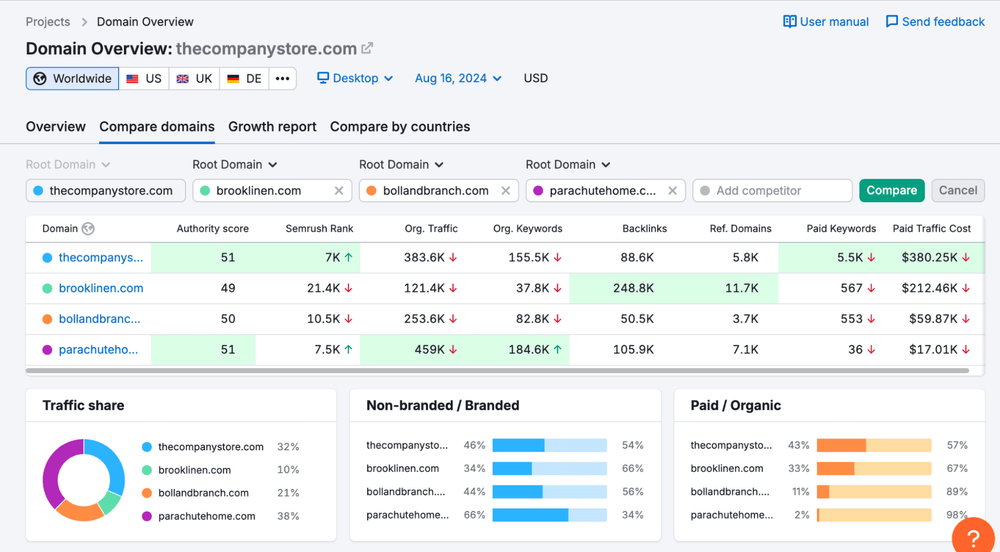
Or focus on specific aspects of SEO with tools that help you understand traffic patterns, identify keyword and content gaps, and analyze competitors’ backlink profiles.
Traditional competitor analysis focuses on rankings and keyword coverage, but GEO expands that scope. In addition to tracking rankings, home decor brands need to understand which competitors are being referenced or summarized in AI-generated results—an emerging layer of competition beyond traditional search. That shift requires brands to evaluate not just where they rank, but how their content is interpreted and reused in AI-generated answers.
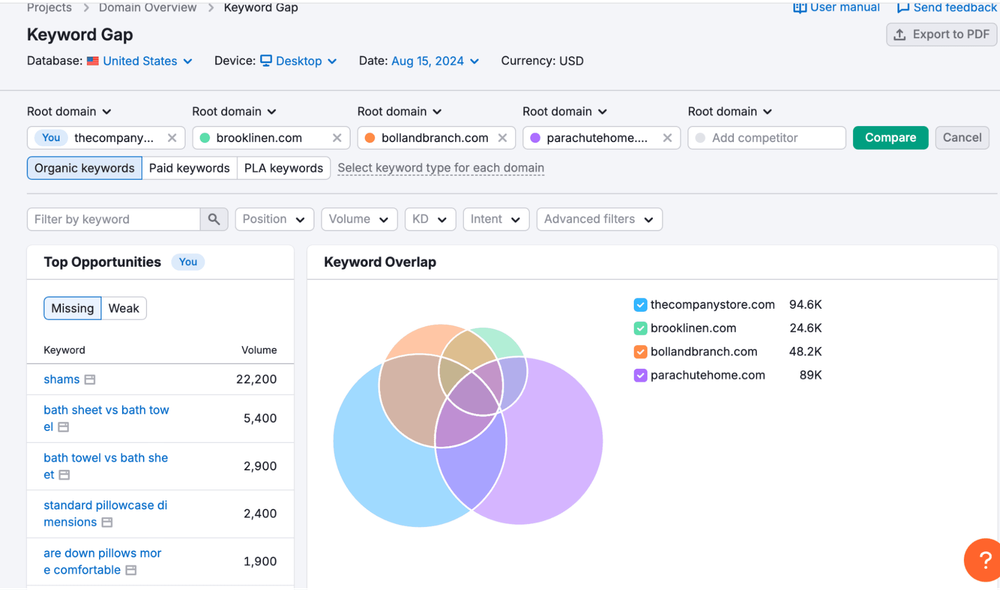
This keyword gap information for The Company Store, for example, shows me that we should evaluate existing content about choosing bath sheets versus bath towels—a topic that a quick Google search reveals is covered extensively on competitors’ sites, but missing from The Company Store. This lack of blog content dedicated specifically to “bath sheet vs bath towel” is a missed opportunity to rank for an important industry keyword and earn featured snippets in AI overviews.
3. Target Long-Tail Keywords for Home Decor
Targeting long-tail keywords is basic SEO advice that applies to almost any industry, but bears repeating. This is especially important in high-competition sectors where results for terms like “sheets” are already saturated with content from the biggest and most established brands. Long-tail keywords also align closely with how users phrase prompts in AI-driven search, making them especially valuable for GEO strategies that prioritize conversational, intent-rich queries and more natural language inputs.
I’ve talked in greater detail about choosing keywords, including the difference between long- and short-tail terms, but the succinct version is this: Long-tail keywords are more specific than short-tail keywords—think “floral cotton percale sheets” or “cotton sheets for summer” versus “sheets” or even “cotton sheets”—and therefore tend to have lower search volume but often lower competition as well. In AI-driven search, those queries often take the form of full comparisons or problem-solving questions, such as “what are the best cooling sheets for hot sleepers” or “percale vs sateen for summer bedding.” Targeting long-tail keywords can counteract keyword cannibalization, make it easier to rank for key topics, and move searchers farther along the buying journey.
4. Understand the Importance of Seasonality
The value of home decor search terms fluctuates with the seasons. While some topics—area rugs or lighting, for example—are evergreen, others are in higher demand depending on the time of year.
To create a successful SEO approach for home decor brands, you must first have insight into how shoppers search by season. This can seem somewhat obvious—holiday decor in winter, patio furniture in spring and summer. For GEO, seasonality also affects which content generative engines are more likely to highlight, since they tend to prioritize timely, contextually relevant information.
Google Trends is an excellent tool for greater specificity and insight. Building on the example above, let’s compare “outdoor furniture” and “Christmas decor.”
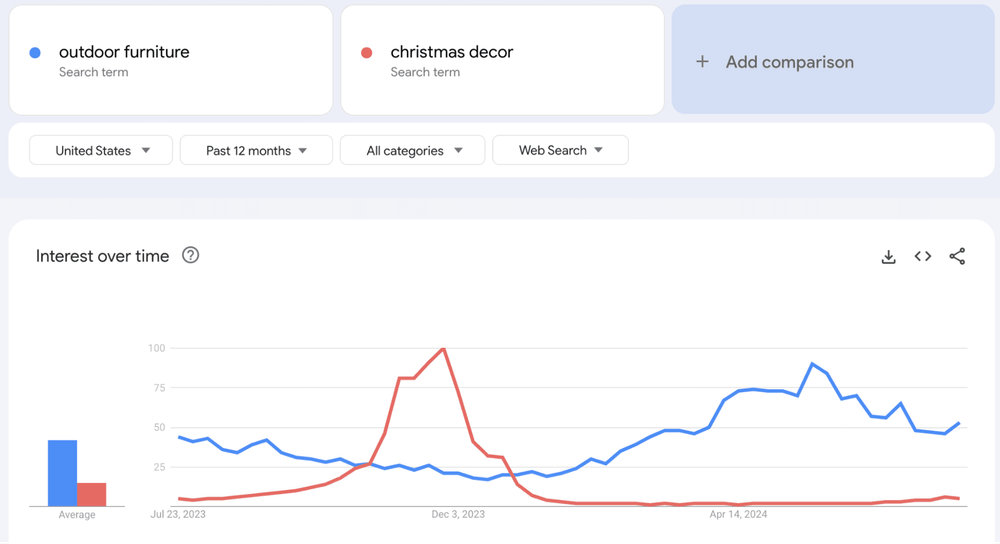
As you can see, “outdoor furniture” starts to gain in popularity in mid-spring, peaking toward the end of May, while searches for “Christmas decor” peak—as you might expect—around Black Friday. This understanding of seasonality can help brands decide when to highlight certain optimized categories in site navigation and when to incorporate seasonal terms into year-round category copy.
I also like to look at seasonality when coming up with content ideas, letting that insight inform not only which topics to cover but also when to publish them. Seasonality allows for a bit of creativity when coming up with content ideas. Yes, winter holidays mean that shoppers will be searching for decor and related tips, making these must-cover topics for any home decor brand’s blog. But many customers are also preparing to host visitors during the holidays, making content on choosing towels for the guest room seasonally relevant, too.
Just don’t sacrifice relevance for creativity: Make sure the topics you choose are still grounded in solid keyword research, support your expertise and product offerings, and target desired consumer behavior.
5. Prioritize Accuracy in Product Descriptions and Category Pages
A background in fact-checking has made me a stickler for accuracy, whether I’m writing product copy or blog content. Accuracy is crucial in SEO and GEO, and not only because AI and search engines prioritize authoritative content; customers value factual information in product descriptions and category pages because it helps them make informed decisions.
Aim for accuracy in how you talk about which products appear on a category page. If a page ranks for “flannel sheets” because the keyword is in the footer copy, but there are no flannel sheets on that page, that creates a poor user experience. The same standard applies to how you describe those products in category copy, and in the details listed for each item (dimensions, which pieces are included in a set, construction, etc.) on its product listing. This level of consistency is especially important for home brands appearing in AI overviews, where conflicting information can reduce trust and limit how content is selected or reused.
More broadly, accuracy matters in GEO because generative engines pull and recombine information from multiple sources. Clear, consistent product details reduce the risk of misinterpretation and increase the likelihood that your content is used as a trusted source. For brands looking to improve performance right now, the most immediate opportunity is tightening product details, aligning terminology across pages, and correcting inconsistencies that could weaken trust signals. Accurate information reinforces a brand’s expertise and helps customers feel confident about potential purchases, compelling them to complete the transaction.
6. Pair E-commerce SEO With Helpful, Optimized Blog Content
When I’m creating content for a home decor blog, I understand it’s my job to make specialized knowledge accessible to the average consumer, empowering them to confidently complete their purchase. Effective blog content plays a central role in any home decor SEO strategy and does three important things:
1. It establishes you as an authority on your main product offerings.
2. It maintains your visibility on the SERP by addressing customer queries.
3. It creates opportunities to deploy an internal linking strategy while increasing the potential for backlinks.
Focus on developing buying guides, care guides, and comprehensive content clusters that support primary product categories. This kind of structured, interconnected content is also valuable for home decor GEO, because it gives generative engines more context for understanding your expertise and surfacing your content in relevant responses.
Buying Guides
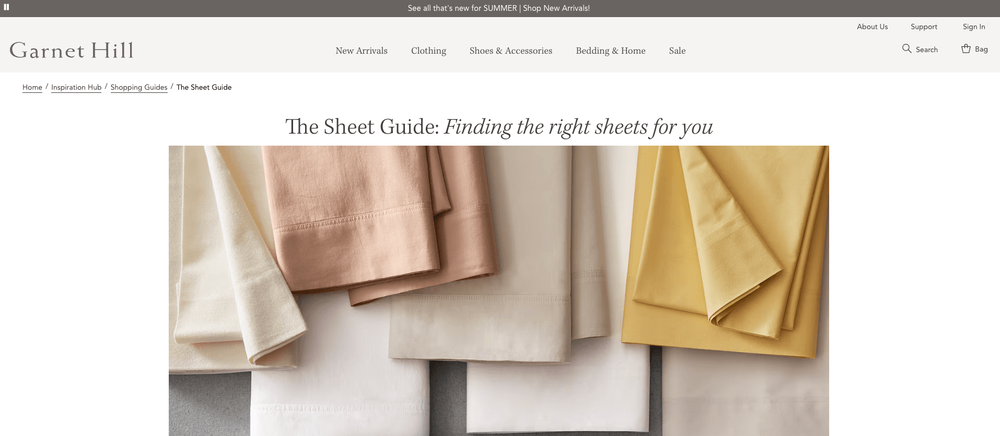
Start your brand blog strategy by creating buying guides for each core product category. This revenue-generating content targets customers toward the bottom of the funnel who are ready to make a decision. Whether you’re selling patio furniture or premium bedding, an effective buying guide will walk shoppers through the important factors to consider. This is where that background knowledge I mentioned earlier comes in handy, allowing you to speak to materials, sizes, construction information, and any other relevant, differentiating details.
Care Guides
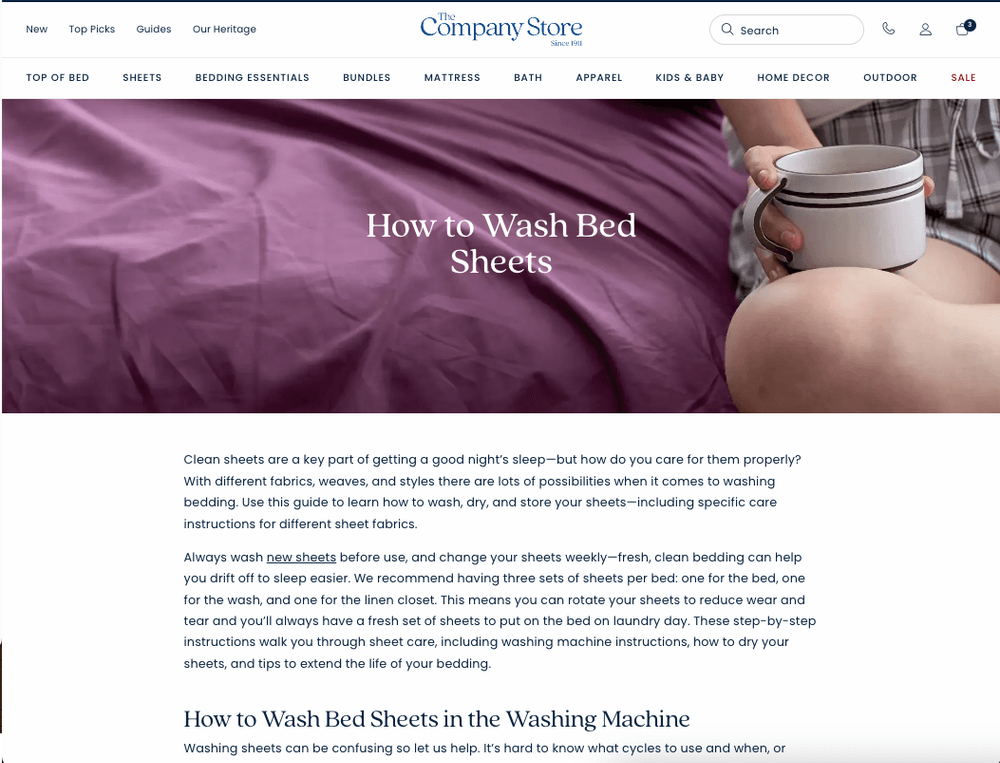
While buying guides target bottom-funnel shoppers, care guides for key products—think “How to Wash Bed Sheets” or “How to Clean Indoor/Outdoor Rugs”—provide helpful information to established customers. This strategy brings shoppers back to your site even after they’ve completed the purchase, which encourages brand loyalty, highlights your expertise, and offers a point of reentry into the buying journey.
Clustered Content
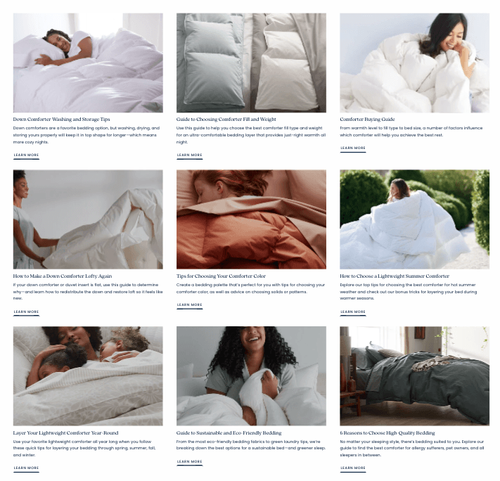
Supplement buying and care guides with content pieces that collectively give customers a 360° view of core product categories. Building up content clusters has been a key focus of our strategy for The Company Store, a longtime client and premium bedding and home brand. In addition to the high-level Comforter Buying Guide, I’ve written blog articles about:
- Tips on choosing comforter fill and weight
- Washing and storage tips for down and down alternative comforters
- The difference between down and down alternative comforters
- Choosing the best comforter for any season
- Tips for choosing comforter colors
- How to make a comforter lofty again
This kind of structure also makes it easier for AI-driven systems to connect related topics and surface your content in more comprehensive answers.
Routinely creating new content in established clusters allows you to target emerging keywords or address overlooked areas. Centering a blog strategy around these clusters creates plenty of opportunities for internal linking and increases the potential of backlinks from social media and other home decor–based sites.
7. Optimize for GEO and AI-Driven Search: What Home Brands Should Do Right Now
As search evolves, it’s increasingly important for home decor brands to look beyond traditional rankings and consider how their content appears in AI-generated responses. Generative engine optimization builds on the same strong foundation as SEO for home brands, but it puts even more weight on whether your content can be accurately selected and reused in AI-generated responses.
At this stage, the goal isn’t to rethink your strategy, but to apply these principles consistently across your site.
When I’m writing for GEO, I’m thinking about whether a page makes sense at a glance. Are the headings clear? Does the copy answer the shopper’s question in a way that can be extracted and summarized? Have I used accurate terminology for materials, decor styles, dimensions, or construction details? In home decor, these distinctions matter. A customer may want to know the difference between antique and vintage, sateen and percale, or an accent rug and an area rug. The more clearly you define and explain those details across your site, the easier it is for both search engines and generative tools to interpret your content accurately.
I also look at whether a brand is covering its core topics thoroughly enough. If you want to build visibility in AI overviews for your home brand, it’s not enough to have a product page and a few scattered blog posts. You need a strong network of content that reinforces your expertise across related topics and supports the customer journey from multiple angles: product descriptions, category copy, buying guides, care guides, FAQs, and blog posts that answer related questions.
In practice, that might mean not only having a page for linen sheets, but also blog content about the benefits of linen, how linen compares to cotton, how to care for linen bedding, and how to choose the best sheets for hot sleepers. That depth helps reinforce your expertise and gives both search engines and generative tools more context to work with.
You can already see this shift in how search results are presented, with AIO summaries pulling together information from multiple sources:
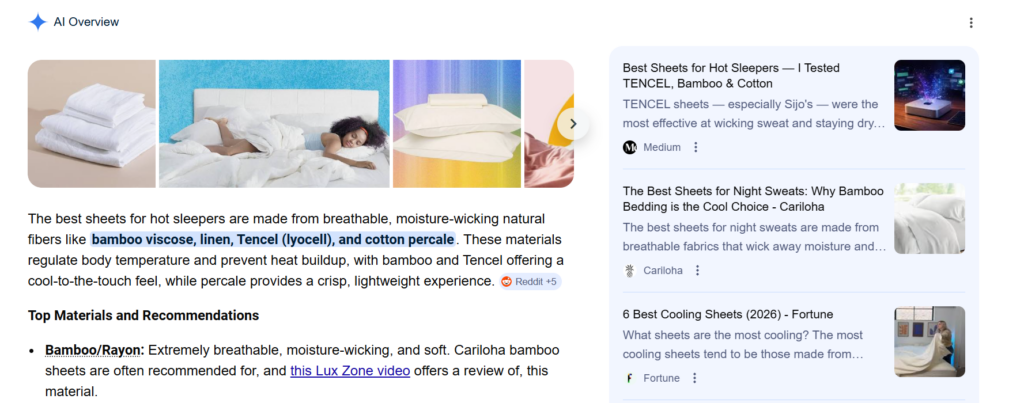
AI-generated search results prioritize content that is clear, well-structured, and specific enough to stand on its own within a larger, synthesized answer.
Accuracy and consistency matter just as much here as they do in traditional SEO, but the impact is amplified when content is being interpreted and reused across different contexts. If your category page says one thing, your product page says another, and your blog content uses vague or conflicting language, that weakens the overall signal. I always want product details, educational content, and category copy to align so the site feels trustworthy and cohesive. The goal is not to write for machines, but to create content that is specific, useful, and well-organized enough to serve real customers, no matter where they get their information.
To put GEO optimization into practice right now, home decor brands can focus on a few key actions:
- Standardize product terminology across your site.
- Add clear FAQs to category and product pages.
- Build content clusters around core product categories.
- Align language across product, category, and blog content.
- Target conversational, long-tail search queries.
How Can an Agency Help With Your Home Decor Brand’s Online Visibility?
When you work with an agency that understands the home decor space, you gain a partner that already knows how to translate product knowledge into effective SEO and GEO strategy. At Eight Oh Two, we have years of experience working with startup and established home decor brands to effectively optimize their web presence. A proven leader in search engine and performance marketing, we remain focused on driving superior results by leveraging best-in-class technology with the very best in human intelligence.
Contact us today to learn how we can help optimize your home decor content, improve your visibility in AI-generated search results, and boost your blog conversions.