

Early-stage content is the stuff of copywriter dreams, the satisfying longform articles that show up in resource guides and blogs across the interwebs. In marketing parlance, it’s also known as top-of-funnel, or TOFU content. It meets people at the beginning of their search journey, when they’re curious, researching, or problem-aware, but not yet shopping. Maybe they’re looking for knowledge about a class of products, or about a multidistrict litigation timeline, for example, but they’re not yet ready to add something to a shopping cart or fill out a contact form.
Back in the day, our two main benchmarks for achieving success in our early-stage content were
- whether it earned high positioning in the search results, and
- whether it compelled a reader to click through to the web page.
Would the curious-minded searcher refill their coffee and settle in to read the thing in its entirety? If yes, then our job was done. And if we succeeded in accomplishing these goals, we could also satisfy ourselves that we were developing brand recognition for a client’s core services or products. In other words, our content was helping transform searchers into potential customers, ultimately driving qualified clicks from them. Boom.
The Truth About TOFU Content Right Now
Historically, we obsessed over TOFU and built entire strategies around answering basic questions, even if they weren’t always helpful to the user. Now, users arrive at TOFU content differently and expect more. Specifically, web consumers are looking for content they can trust. But how do we give them this after we’ve spent years immersed in conventional, historical SEO practices?
I’ll illustrate the answer with a true story. One night, my husband and I returned home late after a dinner party. The first thing I did was open the mudroom door to let our dog out, but an instant later, he had a run-in with a skunk. I happened to remember a piece of content our agency had written for an e-commerce client about what to do in this situation (see “problem-aware” above), and whipped out my phone to pull it up. Soon enough, I found the article, and then buried several paragraphs down, the 1-2-3 steps, and the ratio of ingredients to mix for de-skunking my unfortunate dog.
I had insider info, so I knew exactly where to go. If I hadn’t, I’d have done a standard search (frantically) and then scrolled through what Google served in results, clicking open the most promising-looking links.
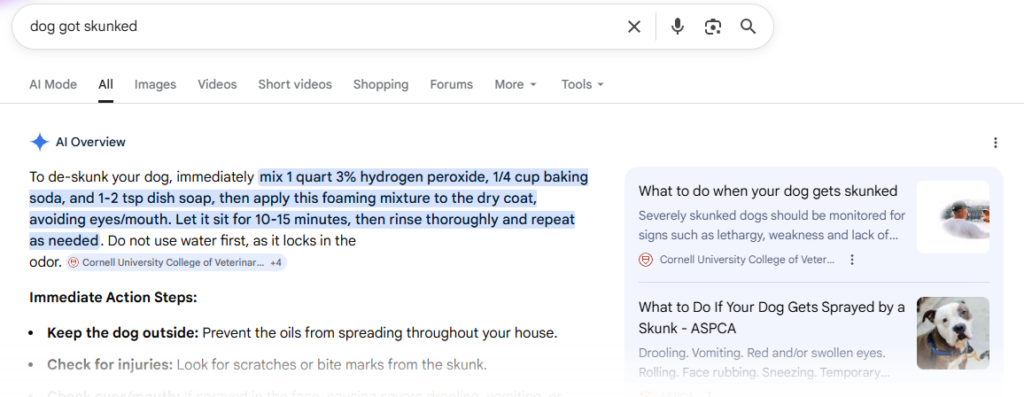
If I search for the same answer today using the keywords “dog got skunked,” the AI Overview will give me exactly what I need to know, up at the top of the page, in compressed results of its own making. It is a composite of what the AI found on the web, and it serves the results to me in only a couple of seconds. I don’t need to click through at all, unless I want to see the resources it pulled from.
And there it is: a quart of hydrogen peroxide, a fourth cup of baking soda, and a couple teaspoons of dish soap. There are some other bullets that give me helpful advice, like leaving him outside (check!), and looking for injuries. It rings true to what our agency-written copy said. Same advice, only the way the search engine served it via an LLM (Large Language Model) is far more convenient and efficient—and in this instance, efficiency mattered a great deal.
What matters even more, though, is the trust-building piece. When I needed help, I wasn’t comparing brands, shopping, or researching options. I was instead asking, Can I trust this source to tell me what to do right now? I happened to know the answer was yes. But now it’s the job of early-stage content to do that for searchers, and so our approach to composition must pivot from the old generalized Q&A format to more meaningful content that answers specific questions readers are asking.
Now we must shift gears and let detailed wisdom flow from our pens (get these supplies, stat!), and yes, even empathetic words (we know it smells awful, but we promise, it’s going to be okay).
The Kinds of Early-Stage Content We’ve Written Historically
The guide for dealing with a skunked dog is a fantastic example of TOFU content we’d have written a decade ago, and in fact, Eight Oh Two Marketing established a name in the Pet vertical with the heavy volume of similar content we published about dogs during that era. We haven’t touched some of that early content in years, but it actually still performs well when measured using traditional metrics, a solid indicator that our SEO approach to this type of content was sound—it wouldn’t have survived this long had we been sloppy.
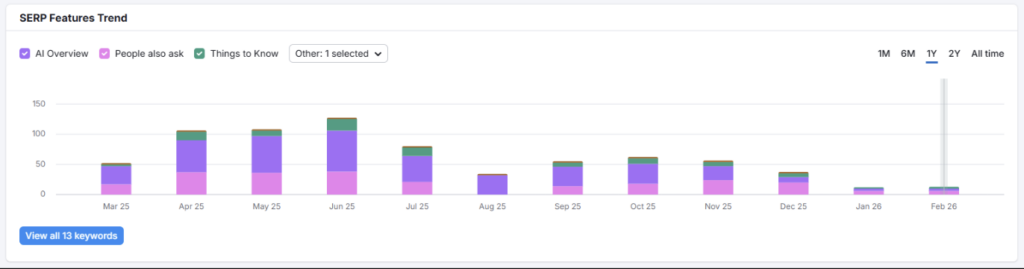
A piece of dog content we wrote years ago for a defunct blog still gets traffic.
We’ve also established a reputation for writing beautiful ‘guide’-style TOFU content for e-commerce sites—fiber stories, how-to-choose content, and even detailed articles showing how a certain type of textile is made, for example. Our eyewear content has guided users in the ways of frame materials and shapes, or which types of sunglasses are best for playing golf versus cycling. We’ve introduced consumers of legal content to complex litigation concepts using language they won’t need a law degree to understand. Our hospitality industry content has helped readers know when to avoid crowds if they’re planning a family trip to the beach, or what to do during a trip to Vancouver in the winter.
All these are examples of early-stage content aimed at people who are learning, worried, or curious. It worked because it was calm and useful, and earned credibility through its editorial authority.
It’s not enough anymore.
Why “Explaining” Alone Is Insufficient in Today’s TOFU Content
The answer is this, simply: TOFU content built on generic, easily summarized information can’t shine anymore because that information is now an easily accessible commodity for users—the nothingburger answers that won’t do a thing to reassure the person frantically searching for a de-skunking soap recipe at midnight, or notably, to earn their trust.
Let’s go back to a truth I revealed at the start of this post: Searchers can get what they need in the AI Overview at the top of the results page, and that’s where the search often ends.
So now our early-stage content must do more than answer basic questions. But while it may not earn clicks, it still does reputational work and provides context for brand expertise upstream. The consumer is not asking “what is this?” so much as, “Is this serious?” “Does this apply to me?” and “Can I trust this source?” If the TOFU piece offers original data, a tool, a POV, a lived expertise, or a memorable framework, it’s not a commodity in the same way—because the information isn’t widely accessible.
Clients historically understood early-stage content was by its nature an introduction to, and exposure for, their brand. It didn’t necessarily drive sales directly, but it was an integral part of the funnel. Today, that funnel remains unchanged, but what has changed is the likelihood a user will be exposed to a brand in a search instance.
So how do we close the gap between what early-stage content has done historically, and what readers now actually need from it in a changed search environment?
How the Same Content Changes in Practice
Returning to our unfortunate skunk encounter for a moment, you’ll recall how our own agency-written content included a recipe for neutralizing soap. We actually did a reasonably good job getting to the crucial point of naming the soap ingredients and ratios in our composition, but on that fateful night I still had to click through and scroll down to find the formula. The post included other interesting but nonessential language about the crepuscular nature of skunks, and how to discourage them from becoming your full-time neighbors.
All well and good, but nobody cares about this right after their dog has been sprayed by that unmistakable malodorous oil. If we were writing the same content today, we’d instead approach it with empathy, specificity, and situational understanding. Maybe the opening would read like so:
If your dog has just been skunked, don’t panic! The good news is that, in most cases, a single skunking is unpleasant but harmless, even though it feels like an emergency. Pause right now and answer this one question: Was your dog sprayed in the eyes or mouth? If the answer is yes, then head to the vet immediately.
If not, relax. This isn’t a crisis. Here’s what to do right now:
- Keep your dog outside, if possible.
- Mix:
- ¼ cup of baking soda
- 2 tablespoons of dish soap
- a quart of hydrogen peroxide
- Apply this directly to your dog’s coat, lather, wait 10 minutes, and then rinse.
- Repeat as many times as necessary—might be several.
When this happened to me, here’s what worked: I followed all those steps to a tee. I kept him in the back yard while my husband tracked down and mixed the ingredients, and prepped the shower. Then the two of us carefully guided him inside and straight to the bathroom. We worked on him for a solid 45 minutes or so until we were satisfied he was comfortable and wouldn’t transfer the oil to anything in the house.
Realistically, expect your pal to smell funky for a few weeks, but taking these actions now will make them more comfortable and keep them from transferring the funk to fabrics in your home. It’s awful—we’ve been there, and we get it. In time, it’ll just be a funny story, we promise.
What “Earning Trust” Actually Looks Like on the Page
To recap what I’ve covered up to this point: TOFU still has a job that includes being surfaced in AIOs, pulled into Featured Snippets, and summarized in SERP Features. This is desirable because it establishes authority, keeps the brand present, and shapes first impressions. All this, and it supports bottom-funnel content (for example, category copy, product comparison pages, or customer testimonials) where we can still make big gains for a client.
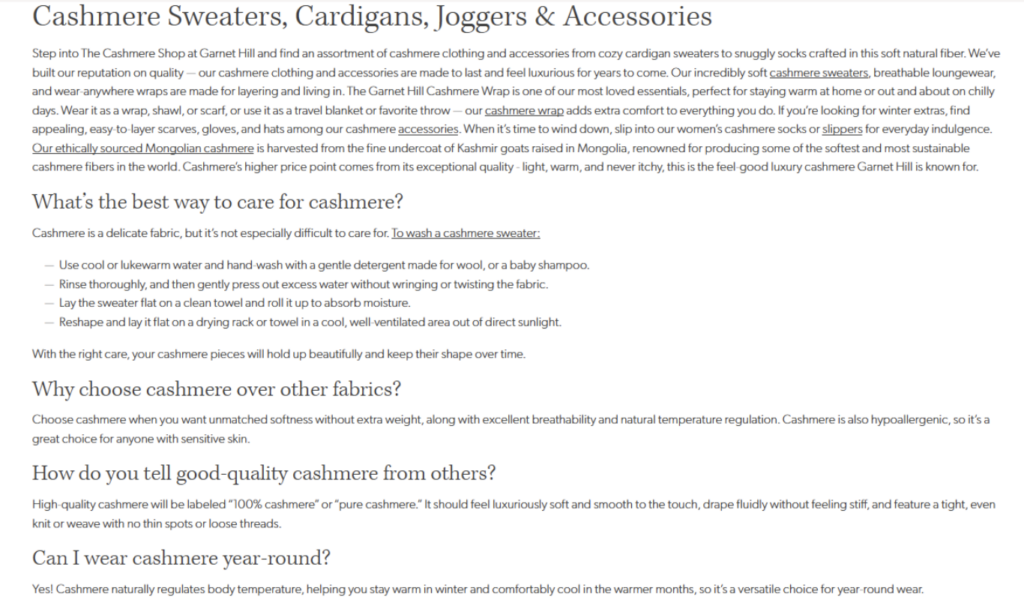
This bottom-funnel category landing page copy answers questions but also links out to other helpful product and guide pages.
What survives in today’s search landscape is experience-led guidance, constraints, edge cases (situations in which typical advice does not apply), specifics, and a clear point of view. So earning trust is not about answering more questions, but about helping readers orient themselves.
This happens inside the writing itself. The best early-stage content now helps a user understand, quickly, what matters and what doesn’t. It assuages anxiety instead of amplifying it. Maybe it corrects bad or oversimplified advice the user has seen already. So it saves them time by narrowing their focus, not expanding it.
This kind of writing earns trust because it feels experienced. It signals judgment, not just knowledge. The user doesn’t need to agree—they need to feel guided. The best early-stage content can also quietly shape selection, even when no one is “ready to choose” yet.
Sounds a lot like something we’re already deeply familiar with, called E-E-A-T—the search quality guidelines Google tells us to heed closely when we make shiny new web content: Experience, Expertise, Authoritativeness, and there it is—Trust.
So here’s how earning trust actually looks on the page now. The website must be the source whose answer (content!) feels reasonable, safe, and trustworthy when it’s summarized. We still write TOFU, optimize it for positioning in the SERP, and it still feeds the answer layer. But we do it with the foreknowledge that readers will find it rendered through another voice. So knowing this, we must make sure what survives compression, is quoted, or paraphrased, represents the brand well.
The Takeaway for Content Teams and Brands
Today’s content marketing teams must now shift their early-stage strategy so that what they write is geared towards providing context for brand expertise. We know it’s unlikely a brand will see organic clicks to TOFU content, but we should also understand it’s still valuable for providing brand signals. While early-stage content still matters, and SEO still matters, the content can’t do all the work anymore.
Instead, reframe your approach to view top-funnel content as a strong foundation that supports your mid- and bottom-funnel content. Understand what you write will still show up, but distilled and expressed in different language. TOFU content is no longer primarily about traffic—it’s about signals. Now we must help our clients adapt to this new search environment by moving away from the old notion of driving clicks, and towards building trust through content that meets the user where they are.
Because, in a world where answers are easy to find, trust is what keeps people reading.