


Authors: Morgan Ferriss & James Glew
Admit it: when you think of bid strategies, you think of maximizing. It’s max conversions, max clicks, max revenue, always maxing things out. Or, if you take it a step further, you’ll be setting a target based on key performance indicator benchmarks. That could be CPA (for max conversions) or ROAS (for max conversion value). But there’s more to it than just a two-way path ahead of us as digital marketers.
To paraphrase Frost, two roads diverged in a Google Ads platform, and sometimes you have to take the one less traveled. In this case, that road less traveled isn’t a road; it’s a bid strategy: Target Impression Share (tIS), specifically for search campaigns.
You don’t outsmart a smart machine by working harder than it. You do it by knowing something it doesn’t. In the right auction, with the right setup, tIS can quietly beat the smart bidding strategies you’d normally default to. It’s a scalpel, not a sledgehammer, so this piece is about knowing the difference. We’re backing it with real campaigns where it won, and a few where it didn’t.
Oh, and with recent (at the time of writing, July 2026) sledgehammer-sized changes coming to those automated-to-the-max bid strategies like target CPA and target ROAS, it’s worth exploring the other options at our disposal this fall.
A Quick Refresher on Target Impression Share
Before we get into where it wins, a quick primer, because tIS works differently from the strategies you’re used to.
Most paid search bid strategies chase an outcome. Max Conversions and tCPA chase conversions, Max Conversion Value and tROAS chase conversion value. tIS chases position. You’re buying visibility, not hunting a KPI.
It isn’t new, either. Google rolled it out in November 2018 to replace two older strategies, Target Search Page Location and Target Outranking Share, and by mid-2019, those old options were gone for new campaigns.
The strategy really only asks you for two things: placement (absolute top, top of page, or anywhere on the results page) and the target percentage (how often you want to show in that spot). Set 90% absolute top, and Google bids to land you in the first position for 90% of the auctions you’re eligible for. There’s a third control that matters more than it looks, the max CPC bid limit, and we’ll come back to it, because it’s where most of the trouble starts. And even though you’re bidding on impressions, you still only pay when someone clicks, so CPC and CTR still matter.
tIS drives efficiency through low CPCs and high impression shares. Obviously, high impression shares, it’s in the name. For some, impression share is more of an afterthought than a bottom-line goal. It’s not a direct success indicator in the same way as revenue or lead volume is. But having a high impression share is always a good thing, if you’re in the right auction. So, make sure you’re in the right auction.
One Catch: It Depends on Your Campaign Type
Google only lets you select from a limited number of bid strategy options based on the campaign type you select. The reasoning behind why each bid strategy is available for what campaign type isn’t all that important. Honestly, it’s arbitrary. When it comes to automated strategies, we’re at the mercy of Google’s allotted selections, so we have to make do.
Here’s a helpful chart showing which bid strategies are available for which campaign types:
| Bid strategy | Search | Shopping | Performance Max | Demand Gen |
| Maximize Clicks | ✓ | ✓ | ✗ | ✓ |
| Max Conversions / Target CPA | ✓ | ✗ | ✓ | ✓ |
| Max Conversion Value / Target ROAS | ✓ | ✓ | ✓ | ✓ |
| Target Impression Share | ✓ | ✗ | ✗ | ✗ |
Where Smart Bidding Falls Short
As we mentioned, most campaigns lean on Max Conversions or Max Conversion Value (for retailers, that means maximizing revenue). Most of the time, that’s the right call. But here’s where those strategies can fall short.
For conversion-based bidding to really excel, it needs data, as much as you can get, plus a healthy budget to run on. As a rule of thumb, Google wants to see at least 30 conversions in the last 30 days before a target-based strategy like tCPA has enough signal to work well, and closer to 50 for tROAS.
That’s all well and good for most digital marketing efforts. But there are a few situations where our hidden gem, tIS, actually does a better job.
Sometimes we dig into an account and find we have more confidence in our product and our ads than in the algorithm running a Max Conversions strategy. If we know that most of the people who see our ads click on them (and we mean most), and we know they’re going to convert, we don’t need to bother with an algorithm hunting for the moment. At that point, the goal isn’t just getting our ads in front of the right people. It’s making sure our ads are the first thing they see, above all else.
Other bid strategies get caught up in finding key conversion moments and limiting when and how ads show to hit a specific KPI. That discipline is what you want most of the time. But it can leave performance on the table in two situations: when we’ve got knockout copy that lands every time, and when the customer is already far enough down the funnel that they’re in a mood to convert anyway. In both, we don’t need Google rationing our impressions. We just need to show up and show up first.
Where It Wins
Across our accounts, three situations keep coming up where tIS earns its place. They share a common thread: we already know the demand is there, so the job isn’t finding it, it’s owning it.
Brand Defense
Branded search is the easiest place to start, because the intent is already baked in. When someone searches your name, they know who you are. You’re not prospecting, you’re meeting a customer who’s already looking for you, and so are your competitors, who love to bid on your brand terms and skim off the top.
Take a home services brand, for instance. Its branded campaign was on Max Conversions with a low bid cap and an aggressive CPA target, and it was only winning about two-thirds of its brand auctions. We switched it to tIS, aimed at the top of the page, with a sensible CPC cap. Once you already know the customer converts, all you have to do is show up first.
- Impression share climbed from 65% to 86% (now it’s never dropped below 90%)
- CPC dropped 14%, down $0.93
- CTR rose from 28% to 33%
- CPL dropped 19%
- CVR increased a further 9%
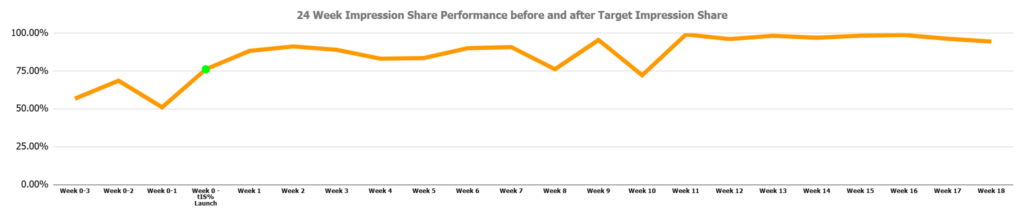
So we won back a big chunk of the brand auctions we’d been losing, and we did it with cheaper, better-performing clicks. On your own brand terms, where you already know the searcher wants you, that’s exactly the trade you want.
Competitor Conquesting
The flip side of defending your brand is going after someone else’s. In a conquesting campaign, you’re bidding on a competitor’s terms, and here you’re the underdog in the auction, not the favorite. That changes what “winning” looks like.
For a Consumer-Focused Major Retailer of FMCG, the goal isn’t necessarily direct sales, especially when a lot of purchasing behavior occurs in stockists, such as major grocery stores. Our goal here isn’t to get customers to click “buy now” online, but to drive awareness and stay present whenever the time to buy does finally come, often in the middle of a crowded aisle, side-by-side with competitors.
That means stepping into auctions dominated by those competitors, and this is where we saw success through target impression share search campaigns.
- Before switching to tIS, campaigns were consistently hampered by low daily spend
After making the switch, with the new bid strategy as our primary change, we tripled impression volume and quadrupled click volume from our campaigns, showing exclusively for competitor terms.
- We even drove impression shares above 10% in highly competitive branded auctions for multiple competitors, including weeks where we were at the top of the auction.
All while maintaining a sustainable CPC and CPM.
For a B2B lead-gen account, we moved a conquesting campaign onto tIS bidding on competitor terms. We didn’t dominate impression share, and we didn’t expect to. In someone else’s auction, you’re rarely going to own it. What tIS did was get us in front of their customers efficiently:
- CPC dropped 53%, from $27.27 to $12.86
- CTR nearly tripled, from 1.5% to 4.6%
- Clicks more than doubled
That’s the real value of tIS for conquest. It’s the most efficient way to buy presence in a competitor’s auction, and because you’re paying per click with a cap in place, it doubles as a clean way to read what each competitor’s traffic actually costs, competitor by competitor. You’re not chasing conversions here, you’re buying visibility and market intel at a price you control.
Dominating a Tight Set of Nonbrand Terms
Quick refresher: Google gives us three keyword match types, exact, phrase, and broad, with a few variants in between. For tIS, we lean almost entirely on exact match. If Performance Max is a comprehensive machine that spends a lot and does a lot across every channel, a tIS campaign is a scalpel, a surgical tool that does a few things extremely well. That’s why we use exact matching.
For an e-commerce retailer, we ran tIS against a tight set of high-intent, non-brand product terms, the exact names of the products themselves. On that set, the strategy did exactly what a scalpel should:
- CPCs on the exact-match product terms ran between $0.05 and $0.29
- Impression share on those terms landed between 52% and 81%
- Those few terms drove the real conversions, roughly $900 in value on just a few dollars of spend
When you point tIS at a small, high-intent set of exact-match terms in an auction you can actually win, it’s ruthlessly efficient. But what happens when you know you can’t win the auction, but at least want a seat at the table?
For retailers with tight margins, sometimes it means gracefully bowing out of more competitive auctions and knowing where you shine. And that’s the correct move for many accounts. It’s why, as digital marketers, we don’t recommend clients to “just target keywords like ‘best stuff,’ and you’ll be set”.
But for a larger brand on a growth trajectory, or a newly expanding business generating buzz, it can be important to show up with the big dogs, so to speak.
Again, a lot of this depends on your goal for the account. Take a company like Levi’s, totally dominating the jeans sector, especially for their branded terms, but when it comes to non-brand terms for ”pants” in general, the auction is so crowded that campaigns set to max conversions, or max clicks, are unable to find a foothold.
That’s where target impression share shines, allowing us to generate brand awareness and cost-effective clicks to the site in a heavily contested auction for general terms previously unattainable under other bid strategies.
After switching from stagnant max conversions or max clicks bid strategies, we saw a major improvement in scalability for general terms like “best snacks” for that aforementioned FMCG retailer.
When It Backfires (and How to Set It Up Right)
Target Impression Share is only a scalpel in the right hands. Point it at the wrong auction, or hobble it with the wrong settings, and it will happily spend your budget going nowhere. Here’s where we’ve watched it break, and the rules those breaks taught us.
When You Trade Value for Position
For a revenue-driven travel and leisure account, we moved a branded campaign out of a mature portfolio tROAS strategy, one with a long performance history across several brand campaigns, and onto a standalone tIS at a 100% target with a tight CPC cap. On paper, it looked safe: brand terms, high intent, just make sure we own the top spot. It backfired, and not for the reason you’d expect.
- Conversion value dropped about 68%, and ROAS collapsed from 7.9 to 2.8, down about 65%
- Conversions roughly halved, and the cost per conversion rose 76%
- Impression share didn’t climb to 100%, it fell, from 69% to 55%
- Yet spend fell only about 10%, and clicks were essentially flat
That last point is the tell. The campaign never got starved; we spent nearly the same amount and drew nearly the same number of clicks. What changed was what those clicks were worth. tIS optimizes for position and has no concept of conversion value. The tROAS strategy we replaced did nothing but weigh value, bidding up on the searches likely to produce high-value bookings and easing off the ones that weren’t, with a long pooled conversion history behind it. Swap that for a strategy that chases position regardless of value, at the same spend, and you keep the traffic while losing the quality.
The cap made it worse without being the cause. The $5 starting limit sat below what the old strategy had been bidding to win the most competitive brand auctions, which is part of why impression share fell rather than climbed. But raising the cap to $9 later couldn’t fix the ROAS, because the missing piece was value optimization, and that was never something tIS does.
The lesson: tIS bids for position, not value. When a mature value-based strategy like tROAS or tCPA is already working on a revenue account, with a healthy conversion history behind it, swapping in tIS trades away the exact thing that was making money. Use tIS to fill a visibility gap that conversion bidding can’t, not to replace a value strategy that’s already capturing it.
When Phrase Match Drags You Into an Unwinnable Auction
Remember that e-commerce retailer, the one where the exact-match terms performed beautifully? That same campaign also contained a single phrase match keyword, a broad product category term, and it tells the other half of the story.
- That one phrase match term ate roughly 98% of the campaign’s total spend
- It sat below 10% impression share, because it was competing in a huge, broad auction, it was never going to win
- It returned about ten cents on every dollar spent
One loose phrase match keyword, in an auction far too broad to win, quietly drained almost the entire budget while the surgical exact match terms did all the real work on pennies. That’s the exact match rule proven in reverse. tIS has no judgment about which auctions are worth winning; that judgment is your job.
This is why the auction itself matters more than the bid strategy. Auction Insights is one of the more useful reports in the platform, and it’s easy to read: a high impression share is good, while single digits are not. But the number only means something if you’re in the right auction to begin with. Picture a home services company that only does repairs, but whose keywords keep pulling it into auctions for parts and equipment. It might post a high impression share, but it’s winning the wrong room. Those searchers want to buy a part, not book a technician. A high share of the wrong auction is just an efficient way to waste money.
The Pattern Worth Remembering
Here’s something we noticed looking across all of these campaigns: in every one, the impression share we actually achieved came in below the target we set. We asked for 100% and got 86%. We asked for 70% and got 32%. Even our winners didn’t hit their targets. The reason was almost always the same: the CPC cap was the real constraint, not the target percentage.
So treat your target impression share as a ceiling you’re unlikely to touch, and treat the CPC cap as the lever that actually decides where you land. Google says the same thing in its own documentation: set that cap too low, and it will keep you from ever reaching your goal.
How to Set It Up, and How to Judge It
Putting the above together, a tIS campaign works when you:
- Set the CPC cap high enough to actually reach your target, not so low that it strangles delivery
- Use exact match and a tight keyword structure, so you control exactly which auctions you enter
- Match the placement (absolute top, top of page, or anywhere) to the actual goal
- Confirm you’re in a winnable, relevant auction before you commit a dollar
And because the usual conversion KPIs won’t tell the whole story here, judge success on the metrics that fit the job: impression share gained, absolute top-of-page rate, CPC discipline, and CTR, alongside whatever downstream signal matters for that account, whether that’s revenue, leads, or simply efficient presence in a competitor’s auction.
| Factor | tIS is the right tool when… | tIS backfires when… |
| Keyword Match Type | Exact match in tightly themed ad groups, with a bounded query set controlled by negatives | Phrase or broad match in open-ended ad groups, where uncontrolled search terms pull you into auctions you never meant to enter |
| Auction winnability (Ad Rank) | Strong relevance and Quality Score make the auction winnable, typically brand or high-intent non-brand | Weak relevance in a saturated, broad-category auction where you’re structurally outranked |
| Max CPC Bid Limit | Ceiling set above the auction’s clearing price, leaving Google room to bid toward the target | Ceiling set below the clearing price, so Search Lost IS (rank) stays high, and you never reach target |
| Conversion Data & Existing Strategy | Volume sits below Smart Bidding thresholds (roughly <30 conv/30 days) or lacks a reliable signal, so tCPA/tROAS can’t learn | A mature tCPA, tROAS, or MCV strategy is already capturing conversions and value efficiently |
| Campaign Objective | Presence-driven: brand defense, share of voice, competitor conquesting, or owning a tight set of high-intent terms | Efficiency-driven acquisition where CPA or ROAS is the real goal |
| Placement Target | Placement matched to intent: Absolute Top for brand and dominance, Top or Anywhere for reach | Paying Absolute Top premiums for low-intent prospecting that doesn’t warrant them |
| How You Measure It | Judged on the levers tIS controls: IS gained, Abs Top IS%, CPC, CTR | Judged only on ROAS or CPA, which tIS doesn’t optimize toward |
Know Your Full Toolkit
Target Impression Share isn’t a secret weapon. It’s just a tool that sits in the part of the toolbox most people never open. And that’s the real point. The strategies that get overlooked usually aren’t bad. They’re situational, and a strategist who only reaches for the popular few is working with a smaller kit than they think.
Smart bidding earns its reputation, and most of the time it’s the right call. But most of the time isn’t always, and the gap between those two is where results get left on the table. Knowing when to step outside the defaults and having the range to do it well is what separates running an account from actually managing one.
tIS is one tool among many. You don’t outsmart the algorithm by muscling it. You do it by knowing the handful of situations where your read on the auction, the creative, and the customer beats its defaults, and by knowing the far larger number of situations where it doesn’t. That’s the whole game.
Impressed by our Target Impression Share strategies, or wondering whether they’d fit your accounts? We’re happy to dig in. Reach out through our contact form, or connect with us on LinkedIn.