

There’s a conversation that happens in almost every paid search account, usually around the time someone pulls a monthly report and notices that Demand Gen isn’t carrying its weight on a last-click basis.
“The ROAS is low. Should we cut it?”
It’s a reasonable question. And it’s almost always the wrong one.
Here’s what we’ve learned managing paid search for a specialty bakeware brand: upper-funnel investment doesn’t disappear. It compounds. And if you’re only looking at direct-response ROAS to evaluate it, you’re measuring the wrong thing and probably making the wrong call.
The Setup: A Brand With an Education Problem
We have a client who makes exceptional bread-making tools. Their flagship product is a temperature-controlled proofing device that helps home bakers maintain their sourdough starter. It solves a real problem. It’s well-reviewed. It has genuine fans.
It also requires explanation.
Unlike a stand mixer or a sheet pan, the average home baker isn’t aware how much it’d up their bread game until they know what it does. That means demand isn’t just captured. It has to be created. Users have to learn that temperature consistency is the reason their starter is unpredictable before they search for a solution.
That’s the kind of product where upper-funnel investment isn’t optional. It’s the engine.
What We Measured and What It Told Us
When we took over the account in late 2025, branded search volume was one of the key indicators we tracked alongside traditional performance metrics. The hypothesis was simple: if our Demand Gen and awareness investment were working, it would show up downstream in brand search volume and branded campaign efficiency. People who learn about a brand through video or display don’t always convert immediately, but they come back.
By early 2026, the data was clear.
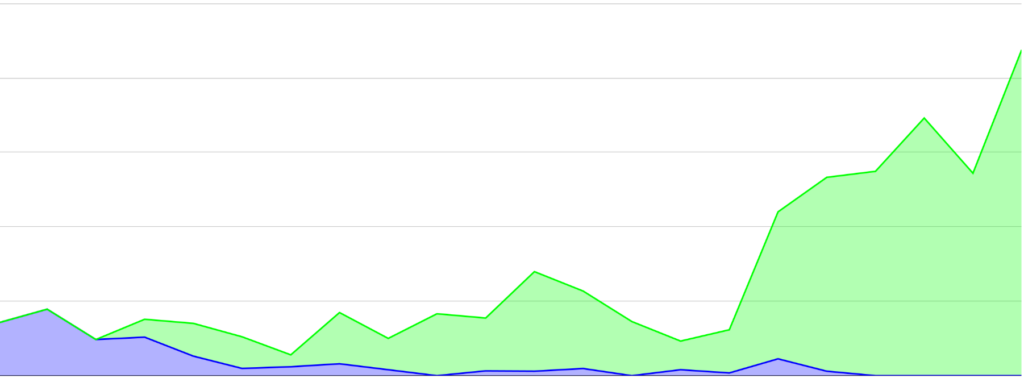
Branded Google searches were up 29% year-over-year. Every month showed growth. Meanwhile, Demand Gen had been running since November 2025, building warm audiences through video and display before the brand’s most critical revenue period.
That’s not a coincidence. That’s compounding.
The Attribution Gap Nobody Talks About
Here’s the other piece most accounts miss: approximately 10% of Google-attributed revenue occurs 14 or more days after the initial click.
For most campaigns, that’s a rounding error. For Demand Gen and Performance Max, it’s structural. Our data showed:
- Demand Gen: 22% of attributed revenue came from conversions 14+ days post-click
- PMax: 16% of attributed revenue landed in the same delayed window
Think about what that means for how you evaluate these campaigns. If you pull a 7-day ROAS window on a Demand Gen campaign, you’re seeing less than 80% of the revenue it’s actually driving. You’re making budget decisions on incomplete data, and that missing data systematically makes the upper-funnel look worse than it is.
The right way to evaluate Demand Gen isn’t on a direct-response basis at all. It’s on a blended basis, combining longer attribution windows, and an eye on what happens to Brand Search and PMax performance in the weeks that follow.
How the Funnel Actually Works
This is the full-funnel picture we operate with for this account:
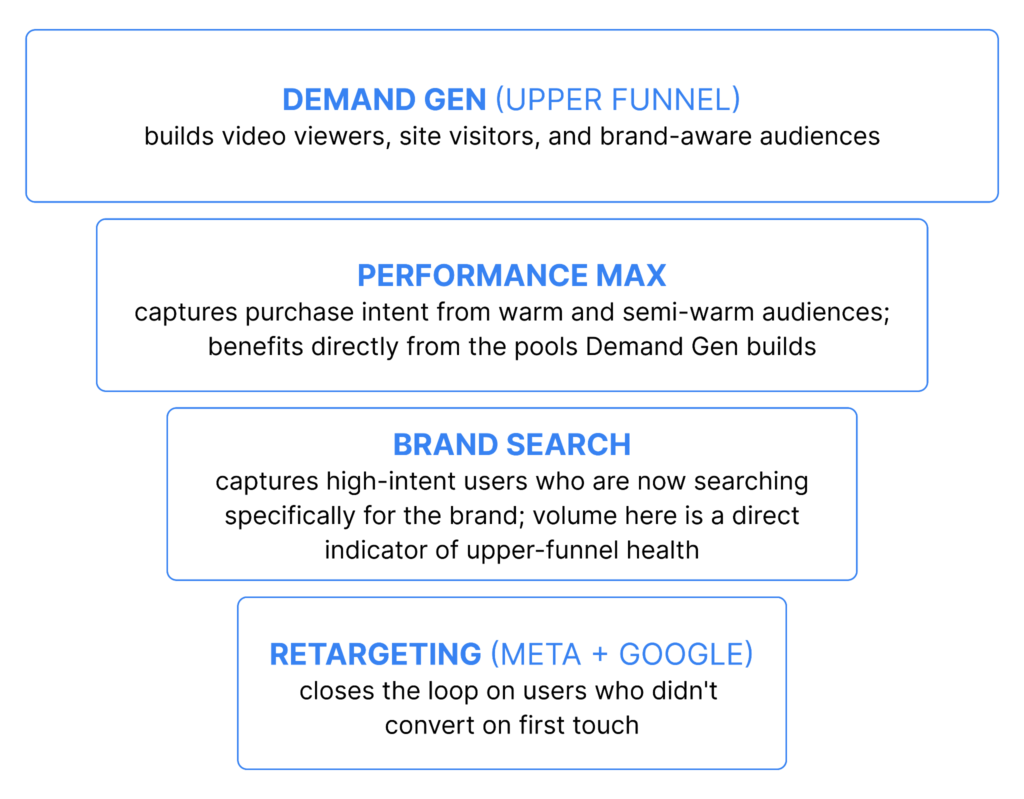
Each layer feeds the next. Success didn’t happen because people spontaneously started searching for a specialty bakeware brand. It happened because touchpoints accumulated upstream, pushing more people into consideration. When we ramp Demand Gen in September and October, we’re not just running awareness campaigns. We’re filling the funnel that Cyber Week will harvest.
The Q4 2025 results bore this out. By the time Black Friday arrived, warm audience pools were deep, retargeting had fuel, and PMax had rich signals. The result was nearly an 11× ROAS on Meta and an 8% CVR on our Holiday PMax campaign. Those metrics don’t happen without the groundwork laid in the preceding months.
The Strategic Implication: Don’t Cut Upper Funnel Based on Direct ROAS
The temptation when budgets tighten is to pull back on anything that doesn’t show an immediate return. Demand Gen is usually the first to go.
But cutting Demand Gen mid-flight doesn’t just reduce impressions. It also starves the bottom of the funnel, just on a delay. The impact shows up 2 to 6 weeks later with declining brand search volume, lower PMax warm audience match rates, and a slowly shrinking retargeting pool.
By then, the budget conversation has usually moved on to something else, and the attribution chain is too difficult to trace back to the original cut. The Demand Gen campaign gets blamed for its low ROAS. Its absence gets blamed on seasonality. The real cause never gets identified.
Our recommendation, proven on this account, is to evaluate Demand Gen on a 30-day minimum attribution window, track branded search volume trends in Google Trends and the Brand Search campaign as a proxy for upper-funnel health, and treat PMax and Brand Search efficiency as lagging indicators of whether upper-funnel investment is working.
Don’t ask whether Demand Gen is profitable in the last seven days. Ask whether brand search is growing, whether warm audiences are healthy, and whether the account is building the foundation it needs to perform when it matters most.
Practical Takeaways
- Set your attribution window before you set your benchmark. Demand Gen and PMax should be evaluated on a 30-day minimum. If your reporting defaults to 7-day click attribution, you’re structurally undervaluing these campaigns every time.
- Track branded search volume as a KPI. It’s a leading indicator of upper-funnel effectiveness that most accounts ignore. If branded searches are growing, your awareness investment is working. If they’re flat or declining, something upstream has broken.
- Start building warm audiences before you need them. September and October investments pay off in November and December. Audiences built during low-cost, low-competition months are significantly cheaper than audiences built during Q4. Front-loading upper-funnel is a budget efficiency play, not just a brand play.
- Don’t evaluate Demand Gen like a direct-response campaign. It isn’t one. Different objectives require different measurement frameworks. Demand Gen success looks like: healthy CPM, strong video completion rates, growing warm audience pools, and downstream Brand Search lift. Not a 4× ROAS in the first two weeks.
- Think about the flywheel, not the channel. Each campaign layer reinforces the others. Brand Search makes PMax more efficient. Demand Gen makes Brand Search grow. Retargeting closes what awareness opened. Remove any piece of the loop, and the whole system runs slower, usually in ways that take weeks to become visible.
Full-funnel investment doesn’t show its value in a single campaign report. It shows up in branded search trends, in audience quality, in the baseline ROAS your bottom-funnel campaigns carry into peak season. Measure accordingly and resist the urge to optimize the part you can see at the expense of the part that’s quietly doing the work.
Want to put this full-funnel approach to work for your brand? Reach out to us via our contact form below, or connect with us on LinkedIn to start the conversation.