


For years, paid search success was driven by optimizations.
You adjusted bids.
You restructured campaigns.
You refined match types.
You added negatives.
And performance moved accordingly. When I audit accounts, many of them are “well optimized”: active management, no glaring structural deficiencies, targets match achieved ROAS. But they are quietly stuck.
Modern Google Ads no longer responds meaningfully to isolated optimizations. It’s not a rules-based system anymore. It doesn’t reset after every optimization; it responds to what you consistently reward.
When I hear, “That didn’t work,” what it really means is “That change didn’t override months of prior signals.” What most advertisers still call “optimization” is actually training. And most advertisers are teaching Ads the wrong lessons.
Why Isolated Optimizations Don’t Move the Needle Anymore
Today’s Google Ads environment is dominated by Smart Bidding, Performance Max, broad match expansion/AI Max, and modeled conversions. These systems don’t reset when you make a change. They learn cumulatively.
If you raise a ROAS target this week, that action doesn’t override six months of reinforced signals. If you launch a new campaign but shut it down after 10 days, the system doesn’t “forget” that volatility was punished. If brand revenue consistently carries the account, Google learns that safe, predictable demand is the highest priority.
The platform continuously optimizes toward the behaviors that:
- Survive
- Get funded
- Hit targets
- Avoid being paused
When accounts plateau despite “strong management,” it’s rarely because bids are wrong. It’s because the system has been trained to avoid uncertainty, but uncertainty is where growth lives.
What Training Looks Like in an Ads Account
On the back end, Google Ads is constantly answering one question:
What does success look like here?
It infers the answer from:
- Which conversions you include
- How you value them
- Which campaigns are protected during volatility
- How quickly you react to performance swings
Over time, those signals shape the system’s behavior:
- Which queries it expands into
- Which audiences it prioritizes
- How aggressively it competes in auctions
- Whether it explores new demand or recycles existing buyers
Training is about the direction you reinforce over months. If repeat customers hit your ROAS target easily and prospecting campaigns fluctuate, which one do you think the system will prioritize over time?
Here’s a pattern I’ve seen more than once.
Month 1: Non-brand drives 52% of revenue.
Month 6: Non-brand drives 36%.
ROAS improves. Everyone’s happy.
Except new customer growth flattens. The system had simply learned that predictable revenue was more important than incremental revenue. That’s training.
How Advertisers Are Training Google Ads Wrong
These mistakes are subtle and are often framed as “good management.” That’s what makes them dangerous.
Mistake #1: Training on the Easiest Revenue
Branded search converts well. Returning customers convert well. Promo periods convert very well. So we lean in. We scale budgets behind what works. We protect it.
And over time, Google learns that predictable revenue is the safest path to success.
Here’s a simplified example:
| Month | Branded Cost % | Account ROAS |
| 1 | 33% | $5.44 |
| 2 | 35% | $5.03 |
| 3 | 40% | $6.10 |
| 4 | 38% | $6.69 |
| 5 | 42% | $7.06 |
| 6 | 46% | $7.39 |
ROAS improved during this period, but incremental demand declined due to the account’s conservative training. This is one of the most common ceilings we see.
Mistake #2: Punishing Volatility
This one hits close to home for most teams. Short-term inefficiency is part of prospecting, but most advertisers respond to it immediately:
- Tightening ROAS targets after one soft week
- Pulling budget during learning phases
- Pausing campaigns that explore new or expanded audiences
From a human perspective, this feels responsible, but from a training perspective, it sends a clear message:
Exploration (uncertainty) is unacceptable.
The system adapts by prioritizing stability over expansion. It narrows the query mix. It leans harder into repeat purchasers. It becomes increasingly efficient, and increasingly stagnant. If everything in your account feels equally clean, you’re probably recycling demand.
Even if ROAS fluctuates, a prospecting or awareness campaign can still drive meaningful new customer lift if given time to mature, as in the example below:
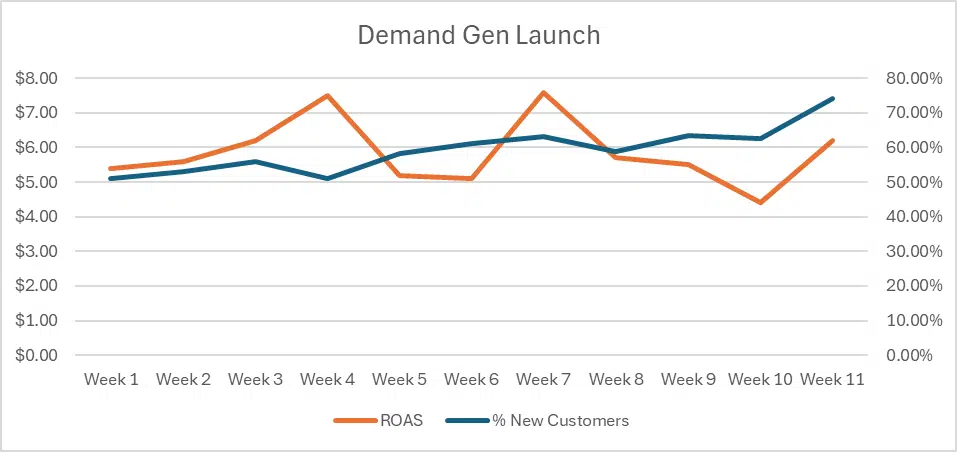
The difference between plateaued accounts and growing accounts is rarely skill. It’s tolerance for controlled volatility.
Mistake #3: Pretending All Purchases Are Equal
In most DTC setups, every purchase is treated equally.
But:
- A first-time, full-price buyer
- A repeat customer
- A promo-driven order
…are not equal signals.
When every purchase sends the same signal, Google will favor the one that’s easiest to reproduce. That’s usually repeat behavior. Then we wonder why new customer acquisition gets harder.
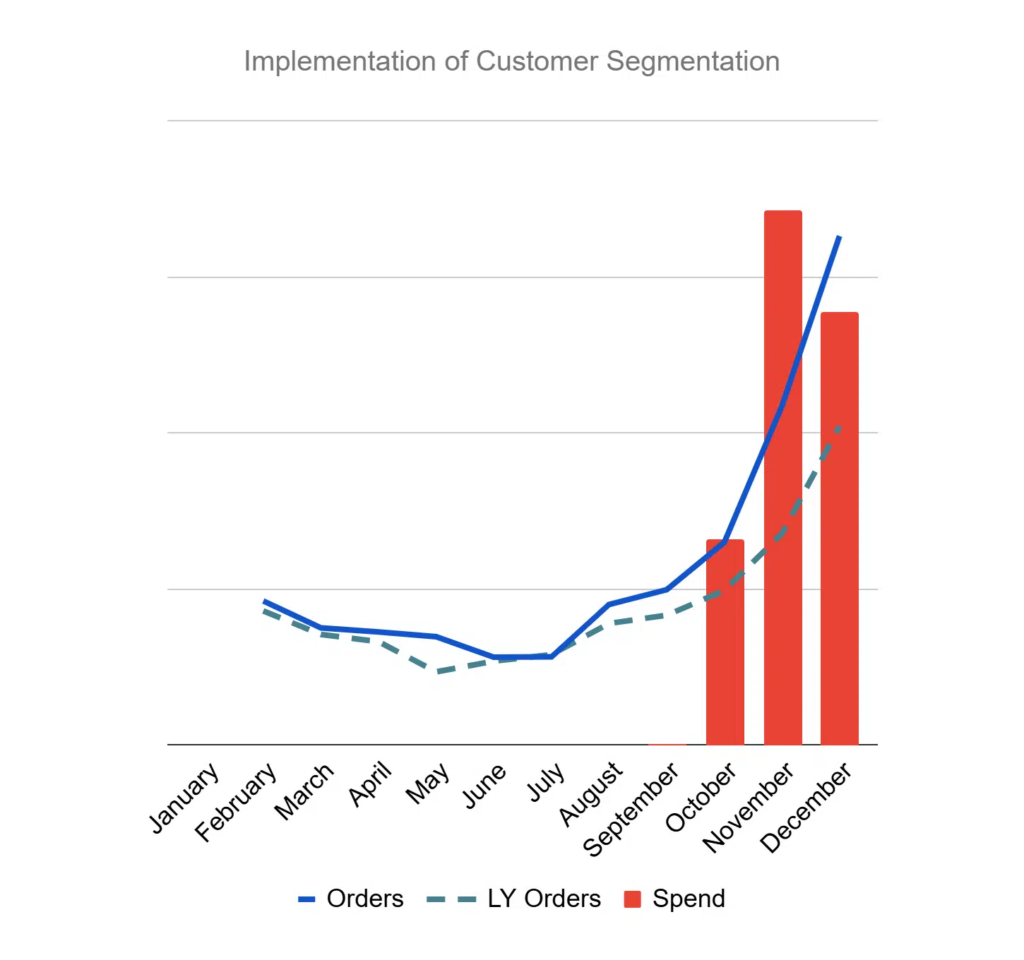
For the client above, the implementation of lapsed customer targeting & valuation led to a 53% YOY increase in orders vs. a 12% YOY increase the three months prior.
What Intentional Training Actually Looks Like
This is where the mindset shifts. And this is where a lot of teams get uncomfortable, because it requires letting go of short-term ROAS obsession in favor of aligning Google Ads with the actual business model.
If a client’s business depends on new customer growth, but you’re optimizing purely to blended ROAS, you’ve misaligned the system from the start. If mis-training is cumulative, so is intentional training. Here’s what that looks like in practice:
Maintain Efficiency Lanes
Efficiency lanes exist to protect baseline revenue. They’re tightly managed. They often include brand campaigns and high-intent non-brand terms with predictable performance.
These campaigns can carry stricter ROAS or CPA targets. They stabilize cash flow. They help CEOs sleep at night. They are not your growth engine.
Build Growth Lanes
Growth lanes are structured differently. They often include broader match types, category expansion, new audience layering, or creative angles that introduce new use cases.
They have looser targets – not reckless, just realistic.
If your efficiency campaigns run at a 500% ROAS target, your growth campaigns might operate at 350%, with the explicit understanding that they exist to expand demand and acquire new customers.
And here’s the key: you don’t tighten the growth lane every time it fluctuates.
You let it learn.
In one DTC account, separating these lanes and holding growth campaigns to a slightly lower ROAS threshold led to a 43% lift in YoY new customers in Q4, while blended ROAS actually improved 10%.
You can see the spend & order relationship below, where an increased investment in New drove measurable change, and the reduction on Returning customers didn’t harm the bottom line.
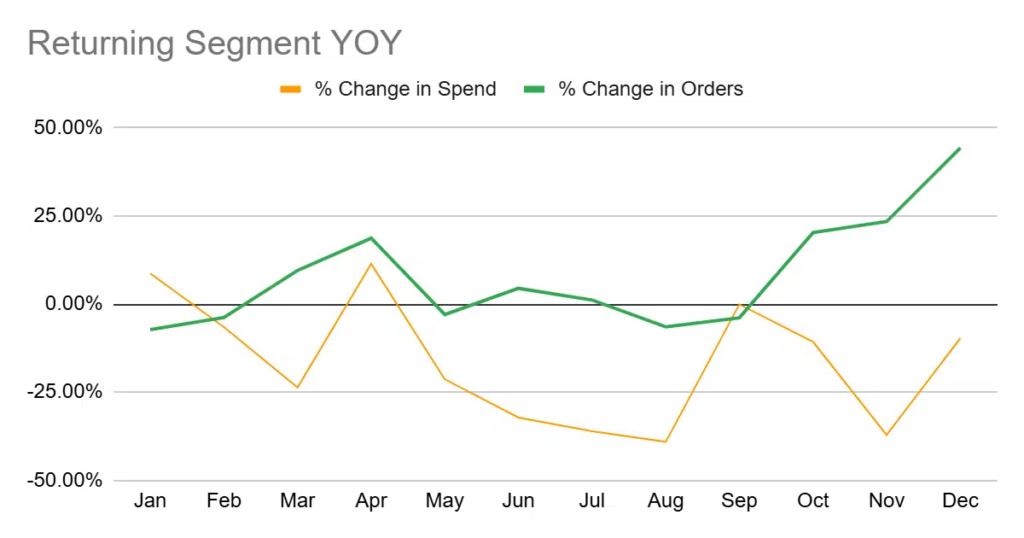
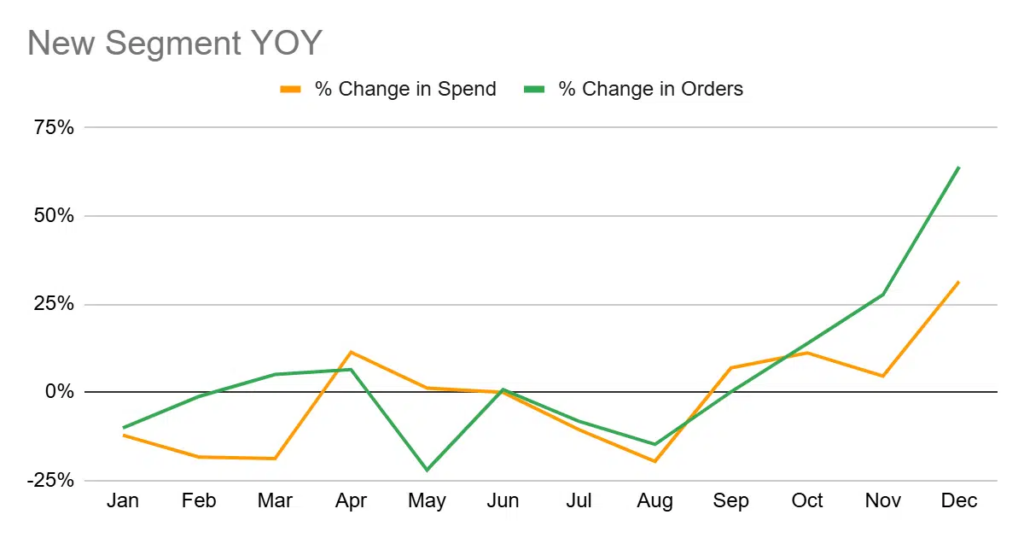
This controlled asymmetry is how you scale smarter.
Change Signals Slowly
If you adjust ROAS targets every two weeks, you’re resetting the system constantly.
Targets shouldn’t be adjusted weekly in response to noise. Campaigns shouldn’t pause during early learning unless structurally broken. Creative testing should be protected long enough to produce a clear signal.
Give it time. Let data compound.
In one account, simply holding ROAS targets steady for 60 days — instead of tightening them after minor dips — resulted in broader query expansion and improved non-brand impression share without increasing spend.
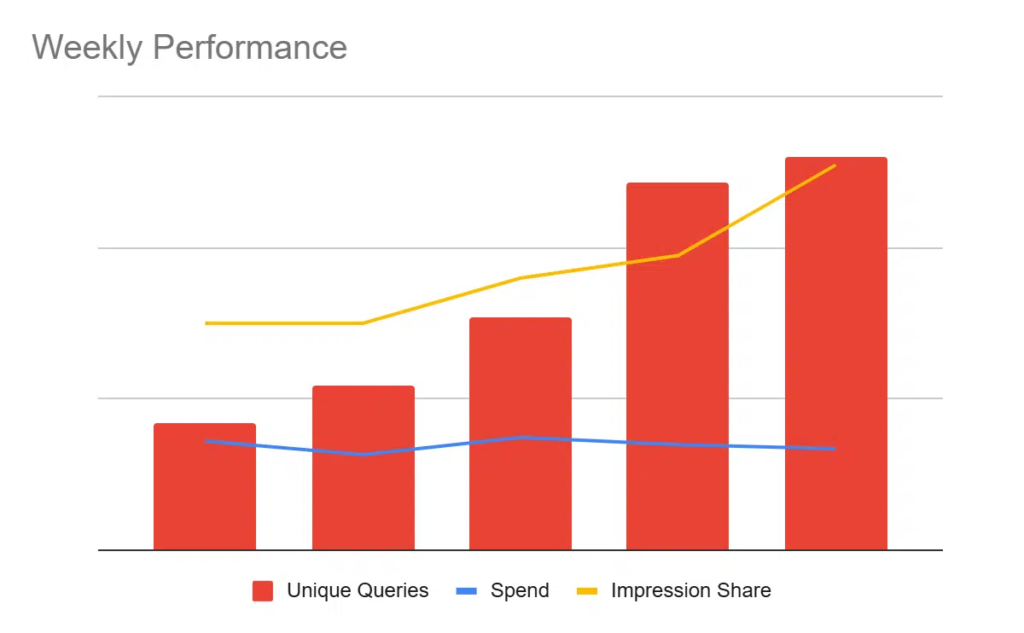
The performance didn’t spike overnight. It grew gradually – that’s training working.
A Quick Self-Audit
If any of the mistakes feel familiar, ask yourself:
- Do we tighten targets faster than we loosen them?
- Has our revenue mix shifted toward brand and repeat customers over time?
- Do we pause exploratory campaigns within the first 2–3 weeks?
- Have our core conversion definitions changed multiple times in the last 60 days?
- Is query expansion flat despite budget headroom?
If the answer is often “yes”, the system isn’t failing you. It’s doing exactly what you trained it to do.
Our Job Has Shifted
Paid search used to be about making better decisions than the auction in real time. Now it’s about designing the environment the auction learns from. That’s a different job.
The advertisers who win in the next phase of automation won’t be the ones who optimize faster. They’ll be the ones who teach more intentionally.
Because once you see the account as something you’re training, not tinkering with, you stop asking, “Why isn’t this working?”
And start asking, “What have we been rewarding?”
That question changes everything.