


Identifying an Opportunity.
This is the story of how to identify an opportunity in Google Ads and capitalize on it using Performance Max.
While there are a lot of internal levers we can pull when running paid search campaigns for retail industry clients, there are always a handful of external forces we can’t eliminate completely. We can, at best, only manage the impact.
The “auction” where our bids are decided exemplifies of one of the greatest external factors impacting campaign success: competition.
How can we control the behavior of competitors who are all driving towards our same goals? The answer is simple: we can’t.
So here’s what we can do. We can mitigate competition challenges through expansion tactics in Performance Max that help drive greater success and a stronger bottom line through digital marketing campaigns.
By taking some time to think carefully about how the language we advertise in can help us compete against those who maybe don’t think outside of their bubble, or stick to a limited worldview.
Languages Beyond English
It goes without saying that when you think of advertising in the United States, there’s one language that comes to mind, that may even be a “default setting.”
But it’s not the only language. Even if it seems ubiquitous, it doesn’t mean it’s the only one you need.
In the United States, there are over 200 million English speakers—more than enough to justify running your core advertising efforts in that language.
But there are 42 million Spanish speakers, 1.2 million French speakers, another million Russian speakers, 1.5 million Vietnamese speakers….
| Language | US Population of Speakers |
| English | 245.7M |
| Spanish | 42.0M |
| Chinese | 3.51M |
| Tagalog | 1.76M |
| Vietnamese | 1.54M |
| Arabic | 1.43M |
| French | 1.22M |
| Korean | 1.11M |
| German | 876K |
| Russian | 975K |
Source: US Census Bureau
The point being, many people speak non-English languages. Searchers think, type, and shop in these languages.
To advertise only in English is to totally eschew the possibility of success in markets built around communities larger than major DMAs, larger than local communities, and larger than your own existing customer base.
It’s an easy thing to forget, but this opportunity is out there; it’s not going anywhere.
Let’s get into the details of how we set up our first Spanish-language Performance Max campaign, and how you can set yours up.
How To Find an Opportunity: The Tip of the Iceberg
We started our Spanish-language Performance Max campaigns in January 2025 after finding successful opportunities in other channels.
Before that point, throughout 2024, our campaigns delivered on a small handful of Spanish terms even without explicit targeting.
“In 2024, less than 1% of 1% of all spend was going to over 10K Spanish terms that had inadvertently been included in traffic across several different campaigns.”
We hypothesized that this was just the tip of the iceberg when it came to expanding our audience. This justified launching a Spanish-language Performance Max effort based on this hypothesis and also on the success we saw in other verticals and through search campaigns for lead gen and driving foot traffic.
Campaign Setup: Language Settings and Ad Copy
Here’s what differentiates a Spanish-language Performance Max campaign from an English one: The Language Targeting Settings.
The first setting change you will make is to Campaign Settings > Other Settings > Languages; type in Spanish to change the language from All Languages (or English, if that is your default) to Spanish.
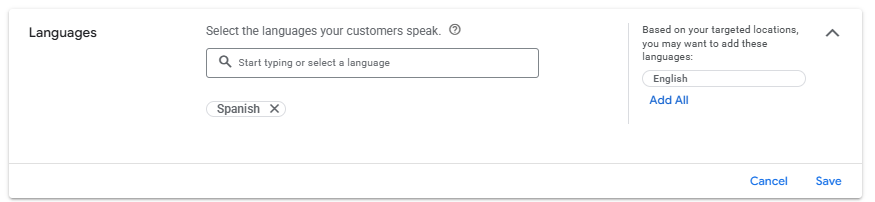
You will only select one language per campaign.
This setting change redirects the campaign’s algorithm from identifying potential customers as “primarily English-speaking” users to seeking customers the system identifies as “primarily Spanish-speaking” users.
The impact will be subtle, but undeniable.
To Translate or Not To Translate
The first thoughts many people have are, “If our landing page is only in English, will that be a problem?” and “Do we need a new version of our site?”
The answer is a firm, resounding “No.” Many people in the United States are multilingual, and Google Translate and other tools make English-language sites totally feasible in conjunction with translated ads.
So you do not need a translated landing page.
You really don’t even need translated ads to go live with this new language setting, but translating your ads will provide a more fluid user experience for customers searching in their respective languages.
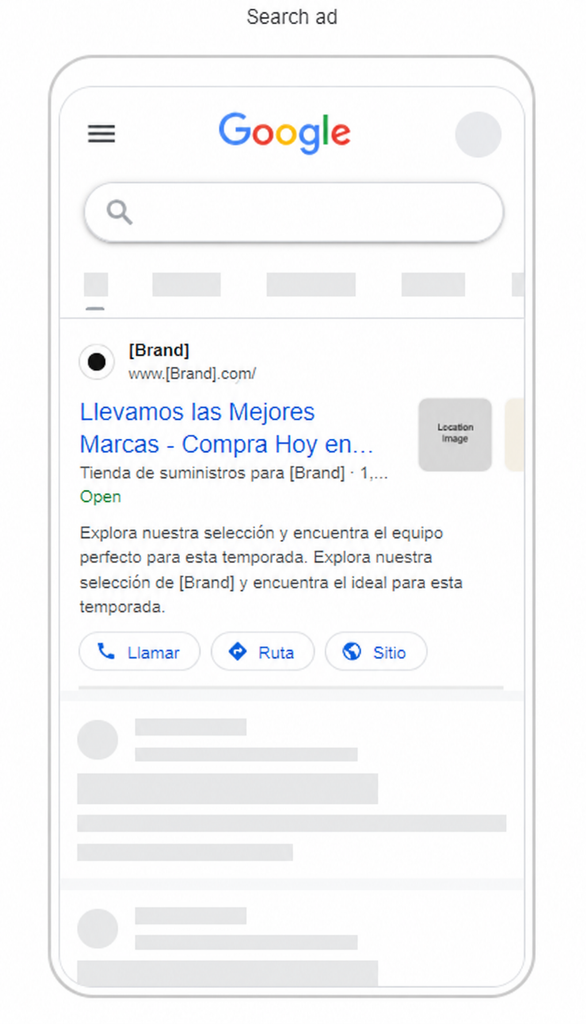
Translated Spanish-language ads within asset groups will typically have a slightly higher conversion rate than ads that use only feed information and product data to create ads.
If you don’t feel comfortable translating your copy, the vast majority of customers and users will be fine with English-language ads. Remember, the strategy is built around targeting settings at the language level. For the most part, the titles of products, even in English, will translate well across language boundaries.
The goal here is to meet users where they are, on their terms, instead of using a wishful-thinking strategy that relies heavily on the algorithm to do the searching and sorting for you.
Language Targeting & Auction Performance
Since a majority of Spanish speakers also speak English, you can anticipate some overlap. This overlap is a necessary and totally acceptable aspect of the strategy to expand into languages outside of English and outside of the default.
And you see this play out in the auction.
With language as the only differentiating factor, our non-brand campaigns drove an 80% impression share in the shopping auction during Q4 2025, while English counterpart campaigns delivered a 50% impression share at comparable spend.
In recent months, even amid Google’s alleged changes to its bidding algorithms and language settings, we continue to see Spanish-language campaigns drive a 90%+ NonBrand Shopping Auction impression share by intentionally participating in the Spanish-language auction.
There are other benefits of changing language settings to Spanish:
- CPMs averaging at least 25% lower than English campaign counterparts
- Lower competitor impression shares in search and shopping auctions
- Higher ROAS due to lower spend thresholds when budgets are at the testing level
Scaling Beyond English-Language Campaigns
Many of the first and most heavily invested campaigns you run will be in the “default language.” But when you expand to other efforts and channels like upper-funnel video, Demand Gen, or social media platforms outside of Google, you should also consider non-English language opportunities.
Especially if you are driving sales as a retailer.
At the end of the day, the product is going to do a lot of the selling for you in Google Shopping placements. The majority of Performance Max campaigns with a positive ROAS are heavily invested in channels that present like product ads. People see the product; they purchase it. Boom.
Most advertisers will build their strategies, see moderate success, and scale until that success is no longer feasible under the budget. But what happens when you reach that limit?
For us, this is when we grew.
What This Means for You
We aren’t saying you should drop your investments in English if you’re advertising in the US; it is the most commonly used language in the country, and it’s a solid default strategy. It is a best practice for a reason.
But if you want to go beyond the default, you might as well assess your current traffic and see if you have any opportunities elsewhere.
If there is any existing or potential customer base outside of English users, you can leverage this tactic to reach an audience that your competitors aren’t, driving more users to the site, including net-new users.
When campaigns have the bandwidth to reach users across language barriers, these can unlock massive growth and bolster current strategies in ways that are not possible without thinking outside the box.
We see higher impression shares, lower CPCs, and above all, strong ROAS in our retail clients running Spanish and other-language expansion efforts.
In one client’s use case, we took $300 in annual spend on Spanish terms and scaled our efforts to drive millions in revenue from campaigns with expanded language settings.
We now drive a consistent 6% of total revenue each month from non-English language campaigns, at a positive ROAS that brings new customers to our client’s business.
Put Performance Max Opportunities to Work for Your Brand
Impressed by our out-of-the-box strategies, or wondering whether they might fit your accounts? We’re happy to dig in. Reach out through our contact form, or connect with us on LinkedIn.