

Let’s start with the uncomfortable truth: upper funnel doesn’t drive direct revenue. Our awareness campaigns returned $0.24 for every dollar in tracked online revenue last year.
Clients know this as well as we do, which is why YouTube can be a hard sell. A ROAS-focused client sees awareness as spend that will never show a return in their reports, and a test that does get approved could get cut within a few weeks.
And yet, our client grew paid search revenue 12% last year, hit its highest account ROAS ever and lifted Q4 new customer orders 50%, all while putting roughly 8% of spend into awareness. This year, they even approved a YouTube TV test!
We had to change how we sold it, how we measured it, and how we listened. Here’s how we got from “a test that showed a bit of lift” to a client that funds the full funnel year-round, and how you can do the same with yours.
Where we started: “everyone already knows us”
Our client is a specialty retailer with a loyal customer base, a strong ecommerce business and physical stores. They are the go-to name in their category, and they know it. So when you say “awareness,” the reaction in the room is: aware of what? Everyone already knows who we are.
We’d tested YouTube years earlier. Our first search lift study, back in 2021, showed brand searches up 28% among people who saw the ads. That’s a real result, and it proved video gets people searching for the brand. It just didn’t answer the only question the client cared about: did it sell anything?
So the test ended the way most upper-funnel tests end. A nice slide, a polite nod and the budget went back to Shopping and Performance Max, where the ROAS lived.
Here’s what I’d tell any PPC manager in that spot: the client wasn’t wrong. A brand lift number on its own is a vanity metric to someone who’s paid on revenue. Our job wasn’t to argue harder for awareness. It was to change what we were asking them to judge it on.
Step 1: Change the scorecard from campaign ROAS to account ROAS
The single most important shift was the KPI. Instead of reporting on how much revenue GA4 credited to YouTube, we moved the conversation to account ROAS: what happens to the whole account while awareness is running?”
According to a Nielsen MMM meta-analysis commissioned by Google, adding Demand Gen to Search and Performance Max delivers 10% higher ROAS and 12% higher sales effectiveness on average than running those campaigns without it. That’s not “awareness won’t hurt your ROAS.” It’s “awareness makes your bottom funnel more efficient,” because Performance Max is built to capture the demand Demand Gen creates.
That reframe does two things:
- It puts the burden of proof somewhere fair. No one expects a YouTube view to convert on the spot. Everyone expects the account to keep performing.
- It gives the client a number they already trust. Account ROAS is on every report they’ve ever read from us. We didn’t introduce a new metric; we pointed the existing one at a new question.
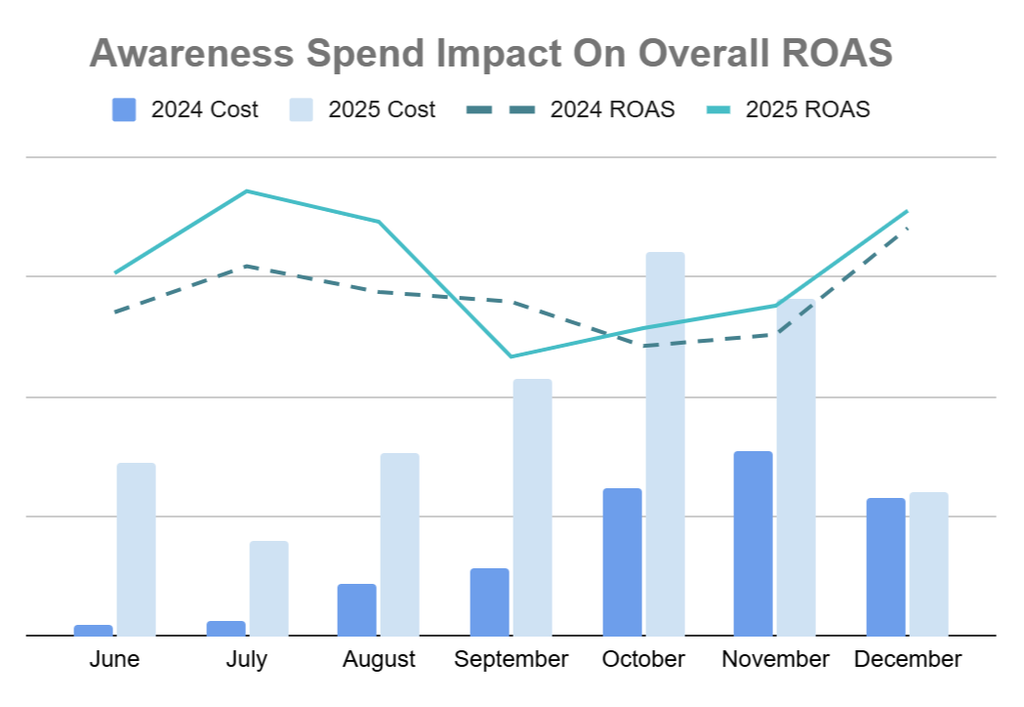
Then we let the account prove it. Through 2025, account ROAS tracked in line with the prior year month over month, even in the months we ramped awareness hardest. It dipped slightly during our heaviest pre-holiday push and recovered into Q4. The year closed at the highest account ROAS the client has ever had, up 16%, with revenue up 12% on roughly flat spend.
The industry data backs this up. Haus’s YouTube incrementality research found YouTube typically drives 3.4x more incremental DTC sales than platform reporting shows. If you judge YouTube by its own conversions column in Google Ads, you’re looking at a fraction of what it does.
Step 2: Lead with the dessert, serve the vegetables with dinner
One of our account managers described our budget strategy perfectly: it’s like getting a kid to eat their vegetables. You don’t put a plate of broccoli in front of them and make a speech. You serve it alongside the things they already love.
For a performance-obsessed client, the things they love are non-brand growth and new customers. Awareness is the broccoli. And deep down, most clients know they need to eat their vegetables.
So when we built our 2H budget proposal, awareness wasn’t a separate line item fighting for its life. It was baked into a new customer acquisition plan, about 8% of total spend, sitting next to the new and lapsed customer campaigns it was designed to feed.
In every budget conversation, we followed one rule: lead with the yummy.
- Open with the revenue story: new customer growth, non-brand performance, what more budget would unlock.
- Introduce awareness as part of how we deliver that growth, not as a separate ask.
- Sometimes that means flipping the order and ending on revenue, so the last thing the client hears is the number they care about.
Don’t call it spin! We framed the ask in language that spoke to their goals and matched how performance is measured internally.
Step 3: Start with the no-brainers
Once the budget was agreed, we didn’t open with our most ambitious idea. We opened with tactics that were nearly impossible to say no to:
- “You already have creator videos. Let’s use them.” Influencer content the client had paid for was sitting idle. On YouTube, it reached each unique user for 33% less than our other video assets.
- “There’s a sale coming. Let’s give it creative.” Promotional video tied to events the client was already investing in.
- “Let’s attach the product feed.” Demand Gen with a feed alongside the creative means every awareness impression can still show a product and a price. It’s an easier sell to a retail client than pure brand video.
Each of these used something the client already owned or already cared about. As long as non-brand revenue and ROAS stayed healthy, nobody questioned the line item.
We launched in June and then ramped from September to build demand ahead of Holiday. Video spend grew 125% year over year. Along the way, we learned what made the money go further. Vertical ads built for Shorts, for example, ran at a 13% lower CPC and 30% lower CPM than horizontal video.
If your client is skeptical, start with creative they already have and promotions they’re already running. It makes upper funnel feel like housekeeping, not a pitch.
Step 4: Prove it with reach and converted users
When we reviewed annual performance, we had better evidence than a lift study. We asked our Google team for a full funnel impact report, showing reach overlap and converted-user data across campaign types. It turned out to be our most persuasive slides.
1. Demand Gen was reaching people search never would. Demand Gen reached 12M unique users. Of those, 11M hadn’t seen a Performance Max ad, and only about 1% overlapped with text ads. We weren’t paying twice for the same shoppers; we were finding new ones.
2. People who saw both converted at more than double the rate.
| Comparison | Saw both | Bottom-funnel only | Difference |
| Demand Gen + Search vs. Search only | 10.6% converted | 4.6% converted | 2.4x |
| Demand Gen + PMax vs. PMax only | 1.1% converted | 0.43% converted | 2.6x |
The second finding is the one the client responded to. People who saw video converted at a higher rate in the Search and Performance Max campaigns the client already trusted, so we could discuss awareness in terms of the campaigns they cared about.
We stacked it with the rest of the full-funnel picture:
- Brand CPCs improved 11% after awareness went live.
- Q4 new customer orders rose 50%, with the extra awareness spend a significant factor.
- Q4 revenue grew 27% year over year.
- Awareness campaigns returned $0.24 in online revenue per dollar, but $2.50 including store visits. For any retailer with locations, omnichannel value belongs in the conversation.
Your Google rep can pull full funnel impact reporting if you ask. Ask.
Step 5: For a brand-new tactic, listen more than you talk
Creator videos and sale creative were easy. YouTube TV was different. This time, the dessert-and-vegetables approach wasn’t enough. We had to find out what the client actually pictured when they heard “awareness”.
We’d pushed for YouTube TV over cheaper awareness inventory for a simple reason: run a premium placement to reach incremental users over buying extra cheap impressions on the same userbase. Our Google team, meanwhile, recommended budgets 5 times larger to make a measurable splash.
Both of us were thinking about what the campaign should look like to us. The client was thinking about something else entirely. Their questions told us exactly what:
- “Can we exclude existing customers?” (On YouTube TV, you can’t.)
- “What exactly is in that audience, and how big is it?”
- “Why open up audiences just to spend more?”
None of those are objections to awareness. They’re fears about waste and loss of control. So we designed the test around the fears, not around our ideal media plan:
- A small, time-boxed first flight: one month, split across standard and premium inventory, at a fraction of the budget Google recommended.
- Tight targeting to in-market shoppers rather than broad reach.
- A second month focused on store markets, with QR-code pause ads that connect a TV impression to a measurable action.
Where it landed
The client that once shelved a YouTube test now funds Demand Gen, video and YouTube TV as part of its standard plan. Revenue is still growing at double-digit rates year over year at an account ROAS the client is happy to keep investing behind.
We didn’t get there by running more lift studies. We already knew that video gets people searching. What changed was trust: the client watched awareness spend sit inside their plan for a full year while the account hit record revenue and ROAS. Once they’d seen that, the next ask wasn’t a leap of faith.
A quick self-audit before your next budget proposal
Ask yourself:
Our job is to sell the whole funnel
Performance clients aren’t anti-awareness. They’re anti-waste. Upper funnel will never win a last-click argument, so stop having one. Change the scorecard, serve the dessert and the vegetables, prove it at the account level, and listen hard before anything new.