


With the rise in consumers starting their shopping with chatbots, product page GEO — Generative Engine Optimization — is essential to staying competitive. Whether you’re an advocate or skeptic, a growing number of consumers are starting their search for products using AI. In fact, our 2026 study shows that 37% of searches start with AI over search engines like Google. This puts more emphasis on GEO, also known as AI optimization (AIO), in making sure people find you out there.
But I don’t want to oversell it and suggest we’re on a road to AI overlords. My golden rule is still: Write for humans, but optimize for machines. The task might sound daunting, but it’s an easier lift than you think to get your product page’s AIO into top shape. It’s just a matter of doing a bunch of little things well.
We’ll go over:
- Why GEO matters
- How to improve product pages in AIO terms
- Answer any lingering questions you may have
Why GEO Matters for Product Pages
Imagine the content on your product pages is your champion out on the internet. It goes to far-off lands to hype your cause and beckon new business to your shores. You want your champion to be seen and heard above the general din and your competition. So you need to optimize it, give it the best tools to maximize its chances of success.
How To Improve the GEO on Your Product Pages
These GEO tips for product pages might seem like a lot, but remember, no one knows your products as you do. Just let your expertise shine through on the right wavelength to catch the eyes of the AI models.
Lead With Facts
There’s plenty of overlap between product page GEO and just strong copywriting. But an AI doesn’t read words in a linear fashion as humans do. Instead, it creates a map of associations based on links, mentions on high-traffic sites, and general context. One simple action you can take is to drop the marketing jargon and lead with visceral facts.
Pro tip: Facts are knowledge and always a value-add.
For example:
| Marketing Jargon | Leading with facts |
| Our pasta sauce is made with premium ingredients. | Our pasta sauce is made with Protected Designation of Origin San Marzano tomatoes. |
Saying a pasta sauce has premium ingredients isn’t really a fact. The word premium is associated with so many things that it becomes kind of meaningless. By contrast, Protected Designation of Origin San Marzano tomatoes are associated with a specific region, a specific flavor profile, and high-end Italian cooking.
Leading with facts also helps with Search Engine Optimization or SEO. This is important because links and mentions help build the renown of your champion and thus boost its visibility to AIs.
My decades of experience in product reviews and e-commerce journalism tell me that the highest ROI is going to be with longer search queries. Algorithms are presenting users with tons of top-of-funnel content, and when a product catches their eye, they’ll drill down. You’ve probably experienced this in your own life. Do you still search for “best kid shoes” or “best shoes for a six-year-old who likes Spiderman”?
I know it sounds like we’re veering off course, but remember, we write for people and optimize for machines.
How Can You Help AI Better Understand Your Products?
Now that you’ve gathered all your specs and facts, it’s time to organize them and frame them. Remember when I said that AI models don’t read linearly, but make maps? They make those maps in chunks. That means the easier your product page is to parse in chunks, the better it is for GEO.
Here is an example of how your product pages may have looked for the past few years:
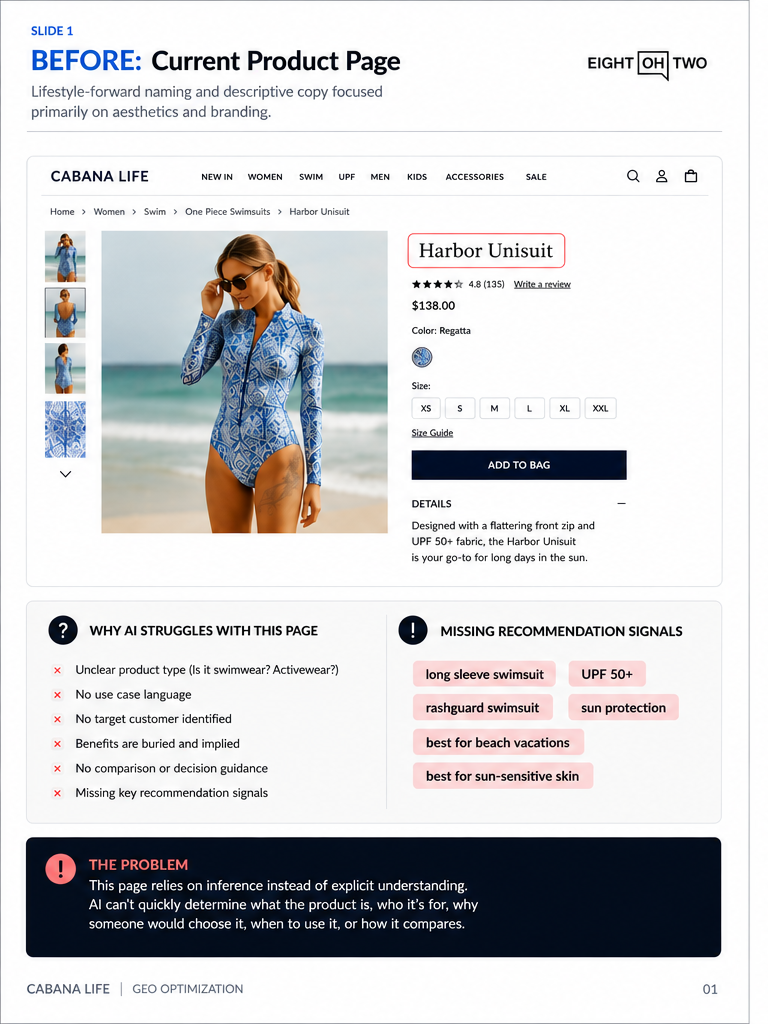
Now, to better optimize product pages for GEO/AIO, we’re approaching product page content like this:
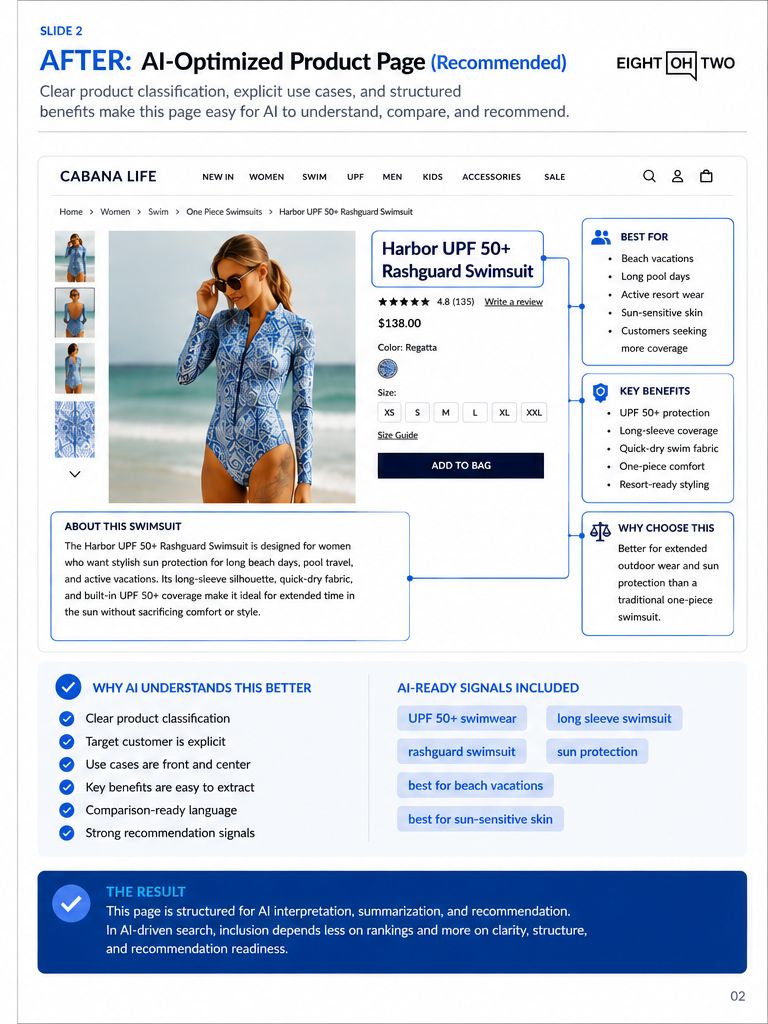
Here’s a quick list of some easy-lift GEO ideas for product pages
- Ensure it’s easy to read and navigate: Use H-tags (H1, H2, H3) correctly, add bulleted lists for quick facts. These and the use of smaller blocks of content are known as “Chunking.”
- Lead with best-for value propositions to call out what sets your product apart
- What it is
- Who it’s for
- Why it’s good
- When to use it
- Make comparisons to competitors to help put your product into context
- Better for X than Y
- Use tables to organize larger comparisons
- Offer contextual internal links for further comparison: “Looking for a warmer backpacking quilt for winter camping? Try the Denali Down Quilt.”
- Use FAQs to easily target long queries about your product
- These should go beyond Google’s People Also Ask questions.
- Anticipate specific questions shoppers may have, or research Reddit and forums to see what people are asking.
- In the past, FAQs might have looked like: “Are Moab hiking boots leather?” Now, FAQs should look more like, “Does the Moab hiking boot have a wider toe box than the Rainier boot?” or “Is the Moab hiking boot better for day hikes or backpacking?”
Straightforward headers can put facts about your products into context. AI also likes to show lists and charts because they’re scannable, and it’s a way to concisely show a lot of data at once.
Pro tip: These recommendations will only work if AIs are allowed to crawl your website. If you’re not sure, use a domain checker that shows which bots have access.
You can also mention how your product stacks up against the competition. Because searchers can easily shop multiple retailers online, it’s a solid strategy to clearly announce why your product page is worth looking at. Are you 25% more affordable or 30% more durable? Your product page is the place to answer these questions.
Speaking of questions, Frequently Asked Questions, or FAQs, allow you to help shape the narrative around your champion. As a commerce journalist, I used FAQs as a deep-dive entry point into a product or brand. FAQs can serve as a pseudo-owner’s manual, a way to address common pain points, but for GEO, they’re a great way to capture search from long-tail queries.
Now, if you’re not sure what questions people may ask about your product or brand, there are tools like SEMrush or Ahrefs that gather metadata from search engines. You can use your product name or brand as a keyword, and these platforms will display the questions people have asked when searching.
FAQs aid in GEO because more searchers are using chatbots to answer questions on the go. People type questions into search engines and chatbots in lieu of perusing the owner’s manual. Because of that, you should include common troubleshooting issues for your product in the FAQs. In addition, you should include more general category questions. These will help capture search from people who are vaguely sniffing around your turf.
How Can You Get Brand Mentions for Products in AIOs?
Oscar Wilde once said, “There is only one thing in the world worse than being talked about, and that is not being talked about.”
AI models favor Oscar Wilde’s view. They tend to rank the things being talked about more highly. Although how they calculate that varies from model to model. Generally speaking, Google’s Gemini equates lots of links as mentions, and models like ChatGPT like it when high-traffic or high-authority sites mention you.
So how do you get mentions and links?
The first step is still to lead with facts and organize those facts in a search-friendly manner. If you run an e-commerce site, then you want to be noticed by commerce and service journalists to put links to your products in their articles.
Speaking as someone with a decade of experience as a commerce journalist, I suggest the more facts, the better the organization, and the higher quality the assets, the more likely I am to pick your product to be featured. Deadlines are always too tight, and the easier it is to search and find information, the better.
There’s also the route of pitching your product directly to editors. But that’s a heavy lift and will require a guide all to itself.
FAQs About GEO on Product Pages
Why does GEO matter for product pages?
An increasing number of people are starting their searches with AI chatbots like ChatGPT. Editing content to catch the eye of AI is a way to drive more customers to your website.
What are some ways to GEO my product pages?
Here are some GEO ideas for product pages that you can implement right now. The first is to lead with facts that help provide context about your products. Next is to use a combination of logical headers, bulleted lists, charts, and FAQs to organize your content so it’s easier for AI models to scan and pull information.
How do I start optimizing product page content for AI?
If you’re lost on where to start, contact us, and we’ll make the process of getting your content to the most up-to-date standards seamless. One of the best strategies for product page GEO is to hand the project over to an expert, someone who does this day in and day out.
How Eight Oh Two Helps E-commerce Sites With GEO + SEO
You could do everything I’ve suggested above: gathering up facts, framing them, organizing them, and writing up comprehensive FAQs. Or you could hand over your spec sheets and a vague idea of how you want your content to look to a company that specializes in doing this all day, every day. At Eight Oh Two, we have experience promoting and writing optimized content for retailers, healthcare providers, law firms, and even hotels filled with ghosts.
If you’re ready to create the ultimate champion for your business, contact us today.