

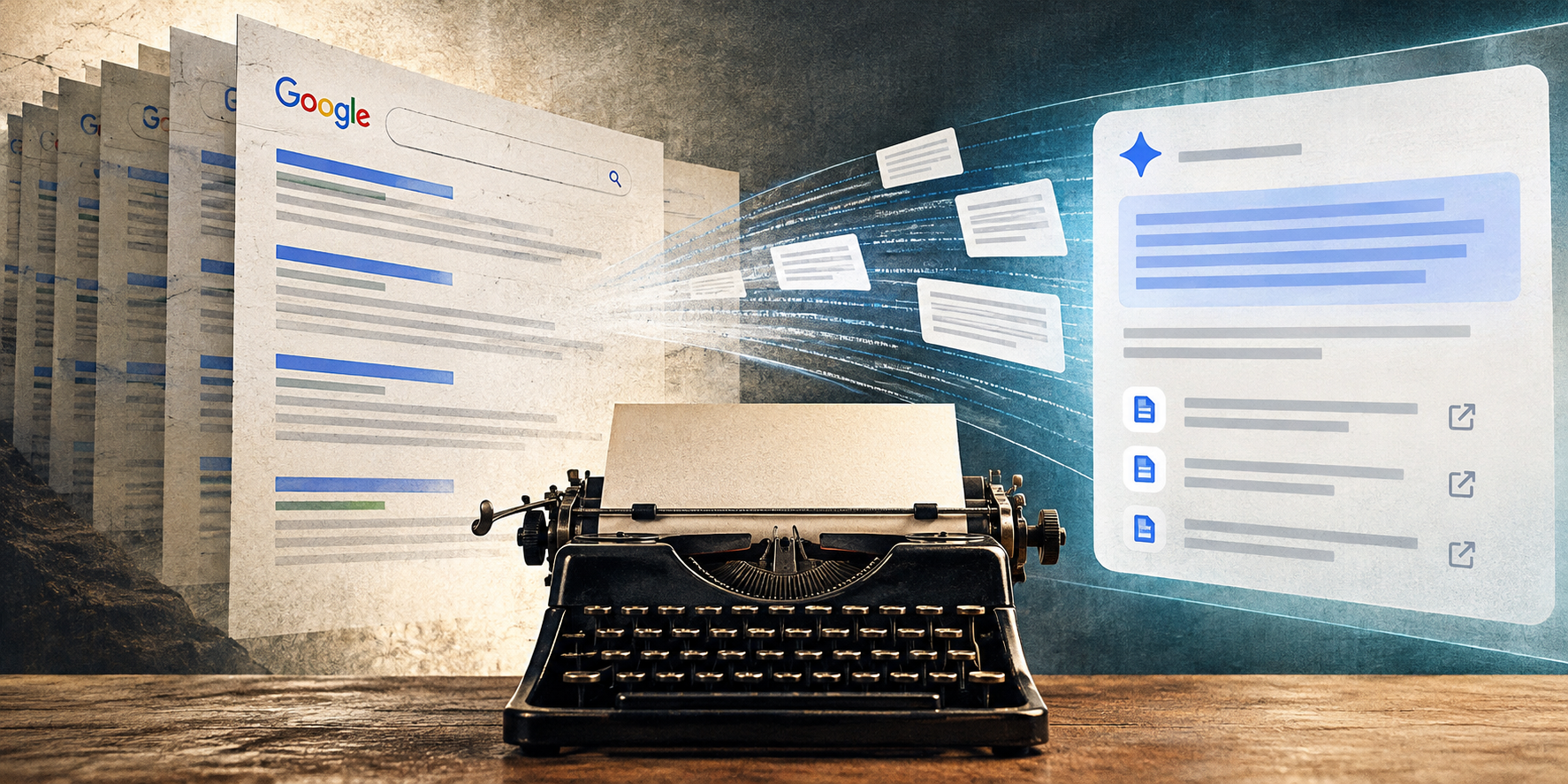
Most longform content on the interwebs—resource guides and blog content, for example—is still written for a version of search that has disappeared into the rearview mirror. In the old paradigm, the goals of longform content were to rank highly, answer questions, and win clicks.
Now LLMs distill the web into quick, synthesized answers for users. So if the click-through is going away, where does that leave longform content now?
Is Longform Content Even Relevant in 2026 and Going Into 2027?
Absolutely. But the best longform content is no longer competing merely to be surfaced—it’s competing to become the source everyone else pulls from. So the goal of the best longform content must move away from being merely “discoverable” to being “definable.”
I’ll give you three examples beyond the scope of SEO to illustrate what I mean:
- The Beatles – defined rock ’n’ roll for entire generations
- Julia Child – defined French cuisine for American home chefs
- Oxford English Dictionary – defined, well, everything
The Beatles didn’t just make songs other musicians still cover; they changed what popular music could sound like. Generations of artists have been borrowing from them, arguing with them, and trying to escape them ever since. Julia Child wrote the book still hailed as the benchmark for French cooking in America. And the OED is arguably the single canonical resource for the English language.
These aren’t just popular works. They are works people:
- Return to
- Build from
- Cite
- Rely on
And that is the new aspiration for longform content.
Yesterday, We Wrote Longform Content for the Ranking Era
We didn’t get our longform content marketing “formula” wrong. In fact, it became a solid cornerstone of SEO for good reason. The type of content we were writing until relatively recently did some noteworthy heavy lifting:
- It offered comprehensive coverage of topics that mattered to clients and consumers.
- It demonstrated keyword breadth through the optimal placement of target keywords and semantic-match terms.
- It gave search engines the authority signals they needed to place the content front and center on the results page.
- It answered a pile of user questions in a single spot.
- It hewed to the “ultimate guide” culture that once ruled the internet.
Not too long ago, we produced this type of longform content for a legal client explaining the difference between medical malpractice by omission versus commission, and it performed admirably for a long time:
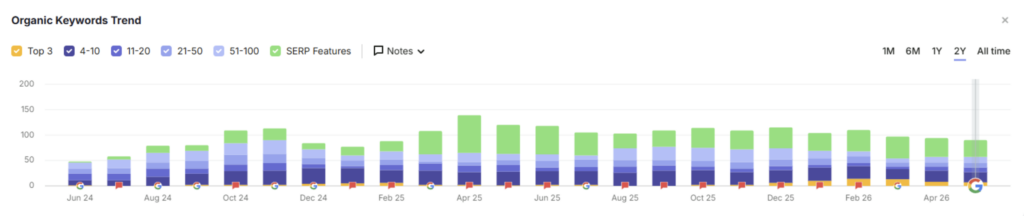
Source: SEMrush
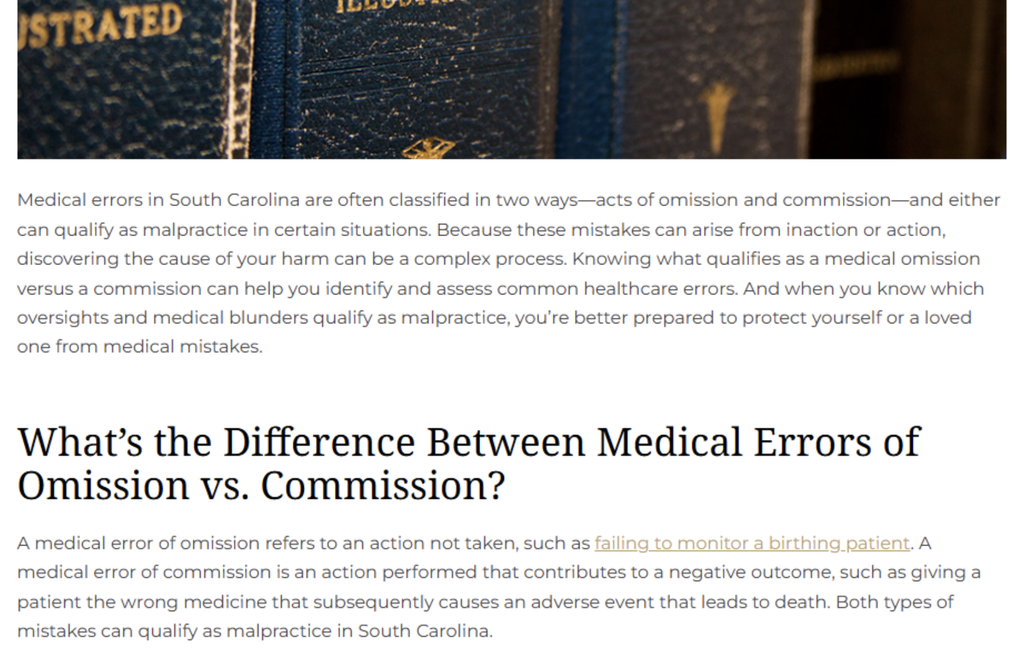
Generative Engine Optimization (GEO) is not magic—the performance of this piece of writing ties back to white-hat SEO tactics we know worked well historically. It worked because it was useful, well organized, and comprehensive. Notably, it was laser-focused on the question the searcher was actually asking, in this case, What is the difference between omission (failure to act) and commission (incorrect action)? And it answered it directly and succinctly:
Useful Content Isn’t the Same as Definitive Content
That article did exactly what ranking-era longform content was meant to do—it answered the question, satisfied the user intent, and earned visibility in Search. But nobody is likely to cite it in a meeting or invoke it as shorthand. Nobody says, “This article changed how I think about malpractice.”
For years, that was plenty. If our content answered the user question better than competing pages—and in this case it clearly did—it stood a good chance at ranking.
Today, answering the question is only the starting point.
Search Has Become an Answer Engine
If you’ve spent any time lately browsing the web for the “best” in a class of products, or looking for answers to specific long-tail questions, you already know you’ll be handed these things on a silver platter at the top of the results. You may not need to click through, unless you want to dive deeply into details.
Going back to the earlier “omission versus commission” example, let’s say I ask Google the following specific question:
I need to understand the difference between omission and commission to see if I have a legit medical malpractice case.
Here is what Google serves me via Gemini:
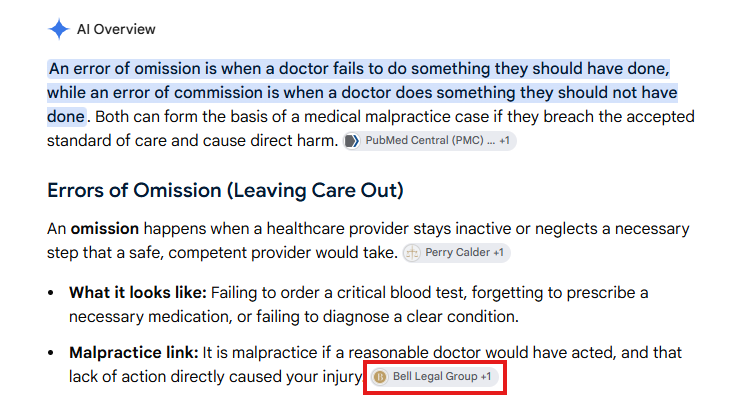
If I’m hungry for details, I can click on a link in the AI Overview to read an entire referenced article. If I continue to scroll, I get a nice compression of answers, along with some differentiators (Do You Have a Case?) right there on the same page. The AI also offers to dig into my specific case more fully for me:
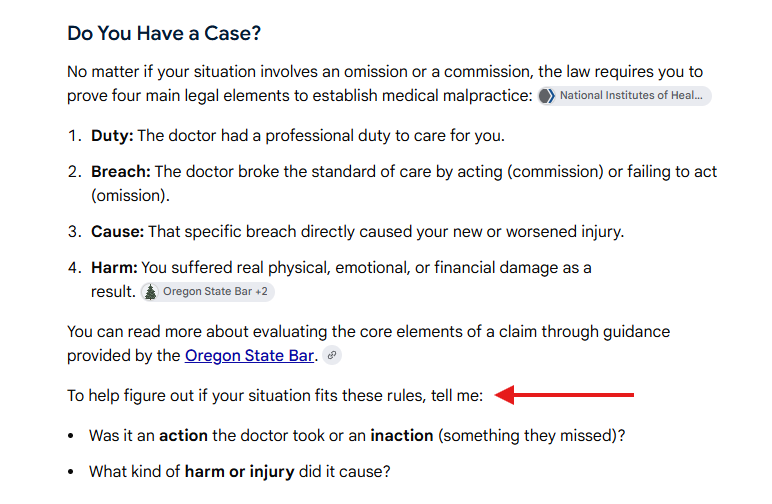
Google’s still citing our content, and that is the job of the best longform content now—not so much to earn rankings, but to be extractable and quotable in the search results. In this instance, the LLM recognized the content as useful enough to cite. AI-ready content is extractable. Reference-worthy content is worth extracting.
Notably, the quality of the writing should remain sound and stick to Google’s E-E-A-T principles (Experience, Expertise, Authoritativeness, and Trustworthiness). It’s also worth noting that when we wrote the “omission versus commission” content, we were trying to rank and earn visibility in AI Overviews. What we didn’t yet have were the more refined guidelines we use today to structure content for AI extraction and help readers make decisions.
Today, these fundamentals have not changed, but the bar is set higher. In any approach to modern web content, it’s crucial to spend some time and effort thinking about specific elements on the page that make the content more extractable for AI systems.
Is this a paradigm shift? Yes and no.
Yes, because it’s now imperative that web content gives the AI systems that parse it the cues they need to reference it. The best content will achieve this through structure, clarity, and extractability that help these systems recognize and interpret a trustworthy and worthwhile resource.
And no, because content quality remains the gold standard. Structure and extractability can help AI systems understand what we wrote, but they can’t make pedestrian information extraordinary. To be truly reference-worthy, longform content has to contribute a thing worth revisiting, or building from, or citing, or relying upon. Like the Beatles or Julia Child or the OED did.
The New Job of Longform Content
As we’ve seen, a citation is valuable, but simply formatting copy so an AI system can extract it isn’t the same as creating content worth citing. What makes it reference-worthy?
- It must contribute something meaningful, such as original thought or information, expertise, a framework, an interpretation, or a unique point of view.
- It must make the contribution usable because it is clear, memorable, quotable, or applicable.
- It must earn trust because it is credible enough for humans and systems to build from.
Here is a real-world example. Our search agency recently authored a consumer-research study as an effort to understand how human search behavior is changing. The approach:
We surveyed 500 AI users to understand when people use AI, when they still turn to Google, and what it means for visibility, conversions, and brand trust. — Eight Oh Two Marketing
This study was consequential not only because it was innovative and useful, but because the results became instantly meaningful and quotable. In fact, Search Engine Land picked up and distilled our agency’s findings into an easily digestible article. As a point of interest, the study actually supports the very thesis I’m laying out in my own post:
Instead of scanning ads and blue links, users want one clear answer they can act on right away. — Danny Goodwin
Our research and subsequent report are not tantamount to writing the OED, and they don’t have to be. Neither does your longform content—you don’t need to undertake a proprietary national study to earn reference-worthiness. “Become the source” can look different depending on your subject matter. But keep quality, substance, and uniqueness top of mind when you’re writing.
Maybe your brand makes a meaningful contribution via:
- Firsthand experience or expertise – you’ve spent 30 years designing fly rods and can explain why two rods with identical specs behave completely differently on the water
- A useful new framework – you’re a financial planner who creates a simple way for couples to decide which debts to pay down first, based on more than interest rates alone
- A distinctive interpretation of existing information – you’re a retailer who sees the same consumer spending data everyone else sees, but recognizes that what looks like declining demand is actually a shift in where customers are choosing to spend
- A synthesis that creates understanding nobody else has articulated quite that way – you’re an employment lawyer who pulls together court decisions, regulatory guidance, and patterns from your own cases to explain what “reasonable accommodation” actually looks like in the workplace
The question to ask yourself before you sit down to write: What does this content contribute that wasn’t already easily available? Don’t stop answering questions. Contribute enough that others can return to the answer, build from it, cite it, or rely on it.
The Bell Legal content answers a question. Our own agency study contributes information that affects how people understand changing search behavior, and that information has been picked up and reused.
Ranking Is No Longer the Finish Line
And the reality is that doing everything right in your content still doesn’t guarantee an AI system will deign to extract and summarize it in a result. AI systems can strip down careful writing into a few sentences, often bereft of the original content’s distinctive voice, that frankly may not give a reader a compelling reason to visit the source material. You can’t control that, not even with the most inventive use of keywords.
But you can control the quality of your content. And holding yourself to high standards is the best response in an environment that offers writers no guarantees. Your content doesn’t need to be iconic like the Beatles’ songs (props to you if it is), but it does need to rise above the noise. The future of longform content belongs to the brands that not only know how to explain things, but can do so meaningfully. Being the reference—that is today’s ambition for the best web content.
Ready to engineer your content to perform in the new GEO landscape? Reach out via the contact form below, or connect with us on LinkedIn to get the conversation started.