


For years, marketers have treated Google as a traffic engine. If you ranked well, you earned a click, and your website did the real work of converting that session into revenue or a lead. For the first time since I have been in marketing, I believe that model is breaking.
Today, more searches than ever end without a click. Featured snippets, AI summaries, local packs, shopping units, People Also Ask, and now generative search experiences answer the question before a user ever visits your site. At the same time, consumers are rapidly changing how they search. Our research into shifting search behavior shows that this is not anecdotal, but structural. More than one-third of consumers now start their search with an AI tool instead of a traditional search engine, and many cite speed, clarity, and reduced clutter as the primary reasons for making that shift.
This isn’t a temporary trend. Zero-click search is accelerating, and brands that don’t adapt with winning GEO strategies will quietly lose visibility, influence, and pipeline.
Why Zero-Click Search Is Accelerating
1. Google Is Optimizing for Retention, Not Traffic
Google’s incentives are clear. Keep users inside its ecosystem longer. Every new SERP feature, from instant answers to AI-generated overviews, reduces the need to leave Google at all. As these features improve, less traffic flows to publishers, brands, and advertisers.
From Google’s perspective, this is working. From a marketer’s perspective, it is the continuation of a shift that has been underway for years. What is different now is the speed. The search experience has become more crowded, more ad-heavy, and more exhausting for users. In our research, 40 percent of people cite clicking through multiple links as their biggest frustration with traditional search, while 37 percent say they feel overwhelmed by ads and cluttered results.
Key Takeaway: Zero-click features are not just convenient. They are a response to real user fatigue.
2. Informational Queries Are Being Solved on the SERP and by LLMs
Top-of-funnel content is taking the hardest hit. Queries like “Best budget coffee makers”, “Keurig vs drip coffee maker”, and “Is a cheap coffee maker worth it?” are now frequently answered directly in the results. In many cases, they are summarized before a shopper ever reaches a retailer or brand site.
But the shift doesn’t stop at Google.
Large language models (LLMs) like ChatGPT, Gemini, Claude, and others are increasingly replacing traditional search altogether for early research. Instead of clicking through multiple articles, users are asking AI tools to summarize, compare, and recommend, often without ever seeing the original source. Sixty-two percent of searchers say they prefer AI tools because they deliver quick, summarized answers instead of long lists of websites. Nearly half have already used AI to help make a purchase decision, with product comparisons, price checks, and review summaries as the most used tools.
Key Takeaway: If your strategy relies on high-volume informational traffic to drive awareness, you are no longer just competing against Google. You are competing against AI systems designed to synthesize the answer outright.
3. AI Is Compressing the Funnel
Generative AI doesn’t just reduce clicks; it compresses decision-making. Instead of researching across five or six sites, users get one synthesized answer, a short list of recommendations, and a single implied “best option.”
In our analysis of how people use AI for discovery and decision-making, 47 percent say AI now influences which brands they trust, and 47 percent say it shapes what they ultimately buy. That makes the AI-generated summary the new first impression.
This shift from clicks to conversations fundamentally changes how brands show up in search. We explore this in depth in our breakdown of how AI is reshaping search from clicks to conversations, and what smart brands should do now.
Key Takeaway: Fewer touchpoints mean fewer chances to influence the buyer unless your brand is visible inside AI-generated answers. If a brand is not easily understood or clearly differentiated, it is often excluded before a shopper ever reaches a search engine or product page.
The Hard Truth: Ranking #1 Is No Longer the Goal
For years, SEO success meant ranking first. Today, ranking first does not guarantee traffic, brand recall, or even visibility. The new goal is SERP ownership and AI visibility, not just rankings.
Visibility now happens twice. First, inside an AI-generated summary, and then inside traditional search when people look for confirmation. Our research shows that while AI is increasingly the starting point, search engines are still used for proof, especially for reviews, pricing, and credibility checks. When those two experiences do not align, trust breaks. When they reinforce each other, brands become the confident choice.
If your brand is not appearing in featured snippets, AI summaries, or LLM-generated responses, you are effectively invisible even if you technically rank.
What Marketers Can Do About It: Zero-Click Search Marketing Strategies
Zero-click isn’t something you can stop. But you can adapt.
1. Optimize for Visibility in AI-Powered Search
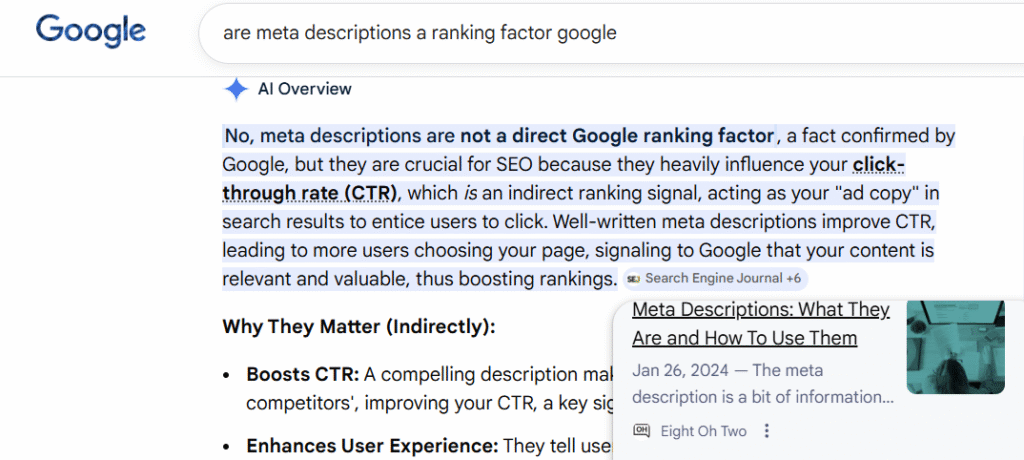
Modern SEO must account for how LLMs ingest, interpret, and surface information. Your content should be engineered to appear in featured snippets, be cited in AI-generated overviews, show up in People Also Ask, and be referenced by tools like ChatGPT and Gemini.
This requires clear structure, strong entity signals, authoritative authorship, and content written to be understood by AI, not just crawled. As we outline in our guide to SEO for AI-powered search and the shift from SEO to GEO, optimization today is as much about training AI systems as it is about ranking web pages.
Even if users don’t click, your brand still needs to be present in the answer.
2. Shift SEO Effort Down the Funnel
Top-funnel traffic is fragile. Bottom-funnel intent is not. Prioritize:
- Product and solution-specific keywords
- Comparison and alternative searches (“X vs Y”)
- Use-case-driven queries
- Local or transactional-based intent
These searches still generate clicks because users are trying to do something, not just learn something.
3. Use Paid Media to Reclaim Lost Real Estate
As organic real estate shrinks, paid search becomes more important. Smart brands are bidding aggressively on branded terms, using search ads to reinforce authority above AI results, and leveraging Shopping, Performance Max, and Local ads to stay visible where organic cannot.
PPC is not replacing SEO, but it is increasingly protecting it.
4. Build Demand Outside of Search
This is the most overlooked and most important strategy for retailers and consumer brands. When shoppers search for you by name, zero-click matters far less. But name recognition does not happen by accident.
Brands that win today are consistently reinforced across the places where discovery actually happens:
- Best-of lists
- Buying guides
- Product reviews
- Creator content
- Trusted publishers
Large language models like ChatGPT do not browse the web in real time. They summarize patterns. Brands that appear frequently in comparisons, guides, and third-party recommendations are far more likely to be surfaced in AI-generated answers and shortlists. If you are not part of that broader ecosystem, you are often excluded before a shopper ever reaches a search engine or product page.
Demand creation for retailers means building visibility and credibility beyond your own site. That includes:
- Earning placements in authoritative guides
- Investing in publisher relationships
- Encouraging authentic reviews
- Creating product content that others reference
This reduces reliance on any single platform as the gatekeeper and increases the likelihood that your brand is included when AI narrows dozens of options into a handful of recommendations.
5. Measure the Right Success Metrics
If you’re still judging SEO purely by sessions, you’re flying blind. For brands, SEO measurement in 2026 should account for shares of SERP and AI visibility, branded search growth, assisted revenue, and product-level influence across the shopping journey, not just last-click traffic. Zero-click and AI-driven search increasingly shape which products are considered long before a shopper ever lands on a product page.
Zero-click and AI-driven search often make traditional analytics look worse, even when marketing impact is improving.
The Bottom Line
Zero-click search and the rise of LLMs are not killing marketing. But they are killing outdated strategies.
The brands that win in this new search era stop chasing traffic for its own sake. They focus on visibility, authority, and intent, and treat SEO, PPC, content, and brand as an integrated system.
Google and other search engines are no longer just where discovery happens. ChatGPT, Gemini, and other AI-powered search experiences are increasingly where discovery begins. It filters options, summarizes tradeoffs, and determines which brands are even considered.
Marketers and brands who understand this shift and optimize for discovery, not the click at the end, will win. Curious what “optimize for discovery” looks like for your brand? Drop us a note through our contact page or connect on LinkedIn, and we’ll help you turn the AI search shift into a clear plan.